Turning the Tables?
The growing use of civil RICO actions by businesses and insurers to respond to suspected fraudulent litigation
Download the full report (PDF)Introduction
The civil justice system operates on a foundation of trust in which attorneys, as officers of the court, file lawsuits after conducting a reasonable investigation to verify the factual basis for each claim. In recent years, this trust has been called into question in a series of cases. In over two dozen cases, businesses and insurers have invoked the Racketeer Influenced and Corrupt Organizations Act (RICO)—a statute enacted to combat organized crime—to challenge what they allege are coordinated schemes to commit litigation fraud.
These actions include accusations of staged automobile and construction site accidents, fake trip and falls, exaggerated injuries, and unnecessary medical treatment or inflated charges. They claim that networks of lawyers, doctors, runners, lead generators, litigation funders, and others are involved in the machinery of bringing these personal injury claims. Other RICO complaints assert patterns of fraud in mass tort, class action, and other litigation.
A common thread in many of these civil RICO actions is that courts and defendants may not detect suspicious patterns across multiple cases, parties, and judges. When questions arise or fraud is exposed, some of the RICO suits allege that the attorneys who file the claims walk away unscathed by dismissing the claim or withdrawing from representing those plaintiffs. This alleged conduct can occur across hundreds of cases, costing those who routinely face such lawsuits millions of dollars, while consequences for filing these claims seem nonexistent. Judges who view one or a few suspicious lawsuits, but may not see full extent of fraud, may be satisfied with clearing questionable cases from their dockets without “satellite” litigation.
Personal injury lawyers typically respond by accusing big corporations and insurers of using RICO actions to attempt to intimidate them, gain leverage in the underlying litigation, or just “kill the plaintiff personal injury bar.”1 But the detailed allegations in many of these complaints, which are often accompanied by supporting evidence, indicate that there may be more than smoke. The recurring pattern described across jurisdictions, defendants, and industries raises a more troubling possibility: that some attorneys, law firms, and others have identified structural weaknesses in the civil justice system and are exploiting them on an industrial scale.
While businesses and insurers who attempt to use RICO in this manner face significant challenges, some courts have recognized the legitimacy of these lawsuits and allowed them to move forward. The most significant judicial development to date is a federal court ruling in Pennsylvania allowing RICO claims brought by Uber and FedEx against a local personal injury law firm to advance. There, the court rejected the notion that attorneys are categorically insulated from RICO liability when alleged fraudulent conduct occurs in connection with litigation. In doing so, the court recognized an important principle: attorneys do not acquire immunity from generally applicable fraud laws simply because the alleged scheme culminates in the filing of lawsuits. Other courts, however, have dismissed similar cases, either as asserting injuries that are too attenuated to satisfy RICO or as alleging ordinary client-referral relationships and third-party litigation financing of medical treatment rather than a RICO enterprise. Federal appellate courts are likely to decide whether these decisions are correct in the coming months.
This paper examines the recent rise in civil RICO actions alleging litigation-related fraud, explains the legal requirements governing such claims, surveys the principal categories of cases filed in recent years, reviews the emerging judicial response, and considers potential reforms. The increase in these lawsuits raises important questions regardless of whether individual complaints ultimately succeed. If the allegations are substantiated, they suggest significant weaknesses in existing mechanisms for preventing, deterring, and responding to litigation fraud.
Important Note
This paper discusses allegations made in public court filings in civil RICO actions. They are unproven allegations only.
Unless otherwise noted, courts have not decided the merits of these cases or determined liability or criminal misconduct.
Nothing in this paper should be construed to indicate that those who are named as defendants in these civil suits have committed crimes. Those facing RICO lawsuits have denied wrongdoing. Some accuse the companies that have brought the actions of improperly weaponizing the RICO Act against them.
Many of the cases discussed in this paper are in active litigation. For that reason, ATRA also cautions that the status of the litigation develops on a day-by-day basis. This paper presents a snapshot at a moment in time. This paper does not express a view regarding the merits of any case, which will be decided by the courts.
Complex Requirements for Civil RICO Actions
Congress enacted the Racketeer Influenced and Corrupt Organizations Act (RICO) in 1970 to combat the influence of organized crime. Generally, RICO makes it unlawful for a person to conduct or participate in the affairs of an enterprise through a pattern of racketeering activity or conspiring to do so.2
While the law empowers government officials to bring criminal prosecutions, Congress authorized persons injured in their business or property by a RICO violation to bring a civil action.3 The Supreme Court recently observed that, under the statute, “[m]ore suits are brought against ordinary businesses than against ‘archetypal, intimidating mobster[s],’” like Tony Soprano.4 Given the high court’s recognition that economic losses flowing from personal injuries may satisfy RICO’s injury requirement,5 the statute can similarly provide a mechanism to respond to costs incurred by businesses and insurers as a result of fraudulent tort litigation.6
RICO violations, however, require more than a dispute over the merits of a case or series of cases. Claims must meet complex technical requirements and can fail for many reasons.7 Plaintiffs must demonstrate a concrete, direct injury to their business or property caused by the alleged RICO violation, “RICO standing.”8 Plaintiffs must also plead and ultimately demonstrate qualifying predicate acts constituting a pattern of racketeering activity.9 Civil RICO actions are often premised on allegations that a defendant committed acts of mail fraud or wire fraud, but they can also include acts such as witness tampering and obstruction of justice. Civil RICO actions must also allege a pattern of racketeering activity committed through an “enterprise” consisting of legally separate individuals and entities acting together for a common purpose– not just a single law firm and its own attorneys or staff, for example. In addition, they must file the claim within the statute’s four-year statute of limitations,10 though earlier conduct may be considered in establishing a pattern of racketeering activity.11
Civil RICO complaints alleging fraud face an additional pleading hurdle. While an ordinary civil complaint must include “a short and plain statement of the claim,”12 a RICO complaint alleging fraud must detail its allegations with particularity, by identifying the time, place, and content of the fraudulent acts and by whom they were made.13
If successful, a prevailing plaintiff may recover treble damages, reasonable attorneys' fees, and litigation costs. Those remedies explain both the appeal of civil RICO and the scrutiny courts apply to such claims. Many RICO claims fail at the pleading stage because plaintiffs cannot adequately allege an enterprise, establish proximate causation, or satisfy the heightened pleading standard for allegations of fraud. Those demanding requirements provide important context for evaluating the recent increase in litigation discussed below.
The Recent Surge of RICO Actions
Although civil RICO has long been used by insurers to combat organized insurance fraud, recent years have seen a notable shift. Businesses increasingly have invoked the statute not merely against medical providers, but against attorneys, law firms, litigation funders, and others alleged to have participated in broader litigation-related fraud schemes. These actions span diverse substantive areas—including automobile and construction site accidents, trip and falls, mass tort litigation, consumer warranty claims, and class actions.
Allegations of Attorney Participation in Fraudulent Lawsuits and Claims
ATRA identified 25 civil RICO actions filed between January 2024 and July 2026 that include attorneys, law firms, or litigation funders as defendants alleging fraudulent litigation schemes.
These cases involve staged construction and auto accidents, and fake sidewalk trip-and-falls. They include cases accusing law firms of transforming minor accidents into million-dollar lawsuits through working with healthcare providers and others to fabricate treatment records and exaggerate injuries. Other RICO actions allege abuse in mass tort litigation, including claims brought by manufacturers of plastic pipes and workplace protective equipment. One RICO action accuses a law firm of routinely seeking recovery of attorneys’ fees based on fictitious billing records in consumer warranty claims. These lawsuits have been filed not only by insurers, but by a wider range of businesses including a rideshare service, a shipping company, construction-site contractors, and an automaker.
These actions typically allege that attorneys and law firms were not merely associated with fraudulent claims, but actively organized, coordinated, and profited from them. Unlike traditional insurance-fraud schemes centered on clinics, medical equipment providers, or pharmacies, these cases strike at the integrity of the litigation system itself because they allege misconduct by those entrusted to serve as officers of the court.
While each complaint alleges a distinct fraudulent enterprise, the cases display striking similarities. Whether these allegations ultimately prove true remains to be determined by courts, but their repetition across jurisdictions and types of litigation warrants close examination.
Staged Construction Site Injuries
New York has a unique law that imposes “absolute liability” for elevation-related injuries on construction sites, which can either stem from a fall or being hit by a falling object. As a result, lawsuits under what is known as the “Scaffold Law” are especially attractive for the state’s personal injury lawyers. At least nine civil RICO actions allege that their conduct crossed the line.
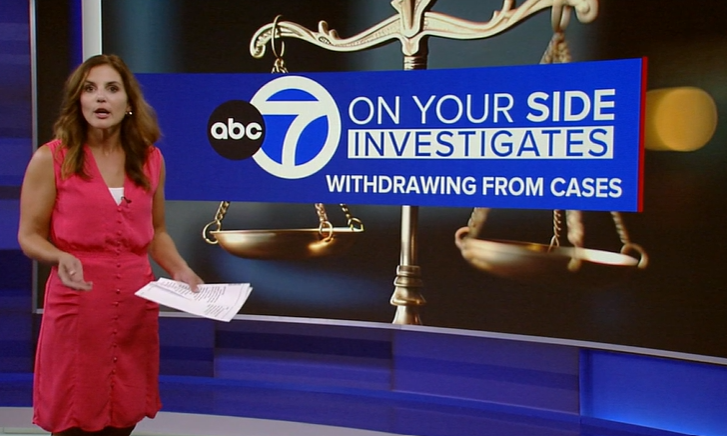
An ABC7 Eyewitness News investigation began looking into suspicious construction site falls, which were plaguing New York projects, raising costs, and driving insurers from the state, in 2023.14 The following year, the station reported that a New York personal injury law firm, Subin Associates, had sought to drop hundreds of these cases—blaming them on a bad referral source.15
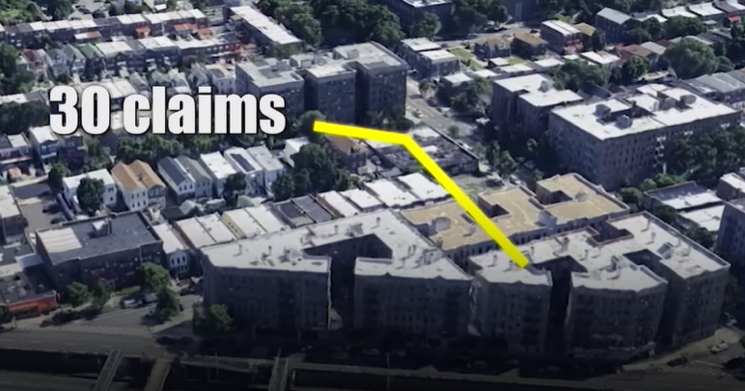
The Eyewitness News investigation later found, after analyzing hundreds of construction site injury lawsuits, that many of plaintiffs claimed to live in the same apartment building or home.16 For instance, an apartment in the Bronx was listed as the home address for plaintiffs in 30 construction injury lawsuits, while 21 more claims were tied to a two-story home directly across the street.17 About half of the construction injury lawsuits identified were filed by the same two law firms, according to the report.18
A reinsurer, Roosevelt Road Re, and its affiliate managing general agency, Tradesman Program Managers, were the first to file RICO actions in response. They have now brought five actions naming New York personal injury law firms as defendants. Others have filed similar RICO actions alleging lawyers participated in staged construction accident schemes, including Ionian Re (another reinsurer),19 contractors operating on construction sites,20 and primary insurers.21 The allegations in these lawsuits vary from case to case. They include that runners under the direction of the law firms enticed workers, often undocumented non-English speaking immigrants, to fake falls at construction sites, set them up with lawsuit loans to provide immediate cash payments, and sent them for aggressive, unnecessary medical treatment to certain clinics to run up the value of the case.
If true, the conduct alleged in these complaints would represent something fundamentally different from aggressive advocacy. The complaints describe an alleged business model built around manufacturing claims rather than prosecuting legitimate ones.
Federal judges in the Eastern District of New York have dismissed four of the reinsurer lawsuits on the basis that their damages are too far removed from the alleged fraud to provide standing to bring the claims.22 The Second Circuit recently affirmed one of those dismissals,23 as discussed on pages 28 to 29. Meanwhile, an action naming Liakas Law awaits the court’s ruling on motions to dismiss as well as a motion for sanctions filed by the firm which asserts that the reinsurers’ flurry of RICO actions is “nothing more than leverage in their campaign of lawfare.”24
| Filed | Court | Docket No. | Caption |
|---|---|---|---|
| 3/1/24 | E.D.N.Y. | 1:24-cv-01549 | Roosevelt Road Re, Ltd. v. John Haggar, M.D., et al. |
| 7/19/24 | E.D.N.Y. | 1:24-cv-05033 | Roosevelt Road Re, Ltd. v. Herbert S. Subin, et al. |
| 9/6/24 | E.D.N.Y. | 1:24-cv-06259 | Roosevelt Road Re, Ltd. v. Wingate, Russotti, Shapiro, Moses & Halperin, LLP, et al. |
| 10/8/24 | E.D.N.Y. | 1:24-cv-07098 | Ionian Re, LLC v. Gorayeb & Associates, P.C., et al. |
| 11/25/24 | E.D.N.Y. | 1:24-cv-07969 | Ionian Re, LLC et al. v. Cedillo, et al. |
| 1/17/25 | E.D.N.Y. | 1:25-cv-00300 | Roosevelt Road Re, Ltd. v. Liakas Law, P.C., et al. |
| 6/16/25 | E.D.N.Y. | 1:25-cv-03386 | Roosevelt Road Re, Ltd. v. William Schwitzer & Associates, P.C., et al. |
| 10/20/25 | E.D.N.Y. | 1:25-cv-05859 | Merchants Mutual Ins. Co. v. William Schwitzer & Associates, P.C., et al. |
| 1/27/26 | E.D.N.Y. | 1:26-cv-00470 | Greater New York Mut. Ins. Co. v. Subin Associates, LLP, et al. |
Staged Falls
Insurers have filed at least five civil RICO actions in the Eastern District of New York against law firms, medical providers, and others alleging that they pursued litigation involving fake falls and injuries, or unnecessary medical treatment, outside the construction context. The underlying lawsuits often allege people tripped on cracked sidewalks outside residential buildings in Brooklyn or Queens.25
An attorney representing an insurer that has filed RICO suits says that the falls typically happen with only a family member as a witness and are filed years after the accident, making obtaining video of the incident nearly impossible.26 In some instances, however, property owners have captured surveillance videos of staged slip-and-falls on sidewalks that served as the basis for lawsuits, which have aired on the local news.27 In one of those cases, the media reported that after it confronted a law firm that filed one of these lawsuits, the firm withdrew from representing the client.28 The question in RICO actions will be whether the law firms were knowing participants in these schemes or they too were duped.
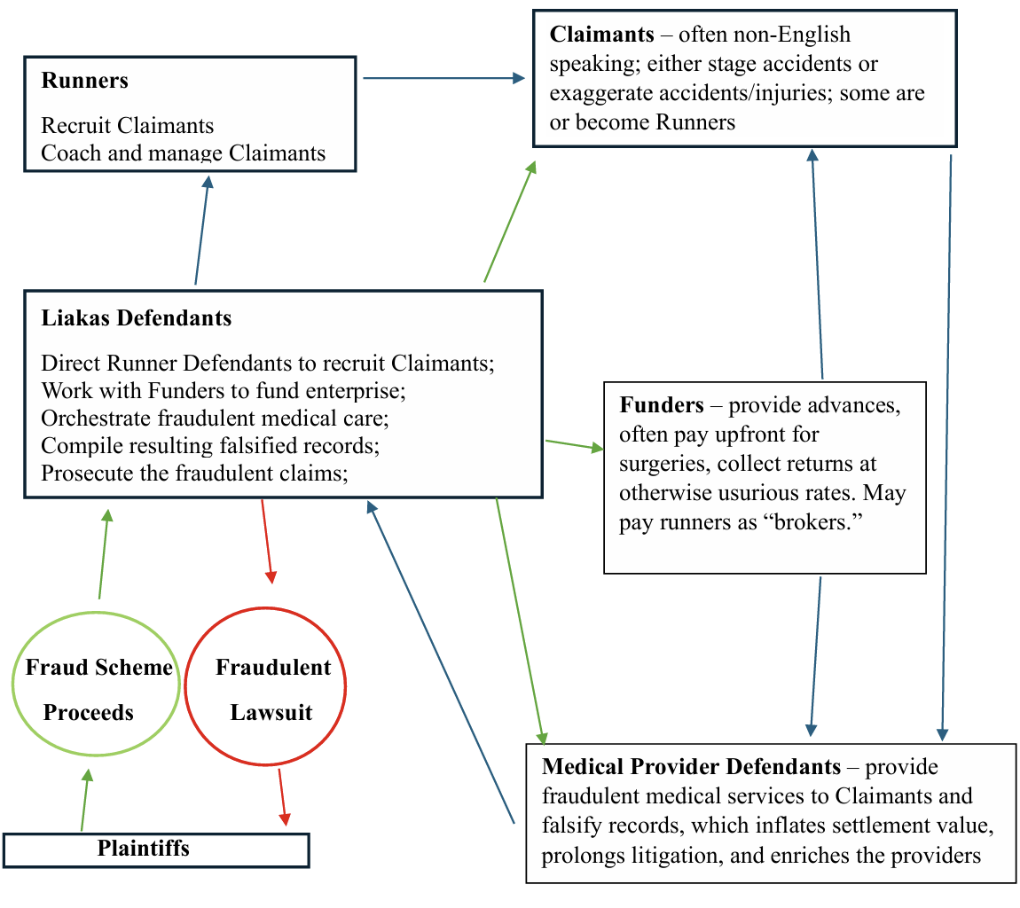
For example, AmTrust (Wesco), an insurance company that specializes in protecting small and mid-sized businesses, claims that Liakas Law directed runners (referred to internally as “investigators” or “paralegals”) to recruit individuals to stage fake trip-and-fall accidents.29 According to the complaint, a significant number of the individuals who claimed injuries are Dominican immigrants who live in Long Island yet claim to have fallen on sidewalks in the Bronx, Brooklyn, and Queens.30 The individuals were allegedly instructed to manufacture or grossly exaggerate specific injuries that purportedly resulted from the accidents.31 The medical providers who participated in the scheme would document false diagnoses and conduct a predetermined course of unnecessary treatment, the most lucrative of which were spinal fusion surgeries, to inflate case values, the complaint contends.32
Litigation funders, allegedly coordinated by the law firm, would pay the medical clinics upfront for the unnecessary and expensive surgeries, and those cash advances would be repaid, at high interest rates, from the claimants’ recoveries.33 The complaint alleges that the claimants “were compelled to cooperate by promises of windfalls by the Liakas Firm, litigation funding often timed with, if not directly contingent on, filing suit and undergoing needless surgeries, by the urging of the Runners, and in some instances, kickbacks by the Medical Provider Defendants and others known and unknown.”34 According to the lawsuit, the law firm would allegedly use the diagnoses and medical bills to extract settlements from insurers who faced a choice: “tender the policy limits or face the potential consequences of an outsized excess verdict.” 35
Below is a flow chart included in the AmTrust complaint36 illustrating how the alleged scheme, which it claims began in about 2020, operates:
Another example is a RICO action Union Mutual Fire Insurance Company filed that names Subin Associates along with runners, litigation funders, medical clinics and doctors as defendants.37 The complaint alleges that a runner acting on the firm’s behalf would target Spanish-speaking undocumented immigrants to use as his victims, enticing their cooperation with instant cash from litigation funders and the promise of a large payday in the future.38 The complaint alleges that the firm represented many claimants who purportedly live at the same addresses.39

The complaint also alleges that the Subin Firm repeatedly dropped groups of cases, totaling in the hundreds, which the complaint contends occurred only after insurers warned them of suspected fraudulent matters.40 “[T]his was by design,” the complaint claims, “[n]ot to rid the firm of fraudulent runners, referrals, and cases, but to cycle to new ones and rid the firm of identified runners, referrals, and cases.”41
| Filed | Court | Docket No. | Caption |
|---|---|---|---|
| 4/3/25 | E.D.N.Y. | 1:25-cv-01857 | Union Mutual Fire Ins. Co. v. Liakas Law, P.C., et al. |
| 5/12/25 | E.D.N.Y. | 1:25-cv-02652 | Union Mutual Fire Ins. Co. v. Subin Associates, LLP, et al. |
| 1/27/26 | E.D.N.Y. | 1:26-cv-00450 | Greater New York Mut. Ins. Co. v. Liakas Law, P.C., et al. |
| 1/27/26 | E.D.N.Y. | 1:26-cv-00470 | Greater New York Mut. Ins. Co. v. Subin Assocs., LLP, et al. |
| 6/2/26 | E.D.N.Y. | 1:26-cv-03300 | Wesco Ins. Co. v. Liakas Law, P.C., et al. |
In August 2026, Judge Orelia Merchant dismissed Union Mutual’s action against the Subin law firm and others in August 2026 without leave to amend.42 Similar to the reinsurer actions in the construction site fall claims, the court ruled that the insurer—in this case a primary insurer—lacked statutory standing to pursue a RICO claim.43 As an insurer of property owners, the carrier’s alleged injuries were “indirect,” the court held.44 Rather, the recruited claimants who took the allegedly usurious loans and underwent unnecessary surgeries, and the property owners who were named in the allegedly fraudulent lawsuits, were those alleged to have experienced direct harm.45 This ruling is further examined in the section of this paper discussing the challenges facing those who pursue civil RICO actions (pages 28-29).
Staged Auto Accidents
Over the past year, Uber, Federal Express, and an insurer have filed RICO actions in Florida and New York alleging that law firms, attorneys, and medical providers conspired with others to stage accidents, provide unnecessary medical care, and file “sham” insurance claims and lawsuits.
Miami Vice
In the first of these actions, Uber sued the Law Group of South Florida and an attorney at the firm who represented each of the claimants in five alleged staged accidents in Hialeah, Florida, a city in Miami-Dade County.46 The defendants also include medical practices, physical therapists, a physician, and nurses that worked at these facilities. In addition, the complaint names five Florida residents as defendants who allegedly drove the colliding cars.
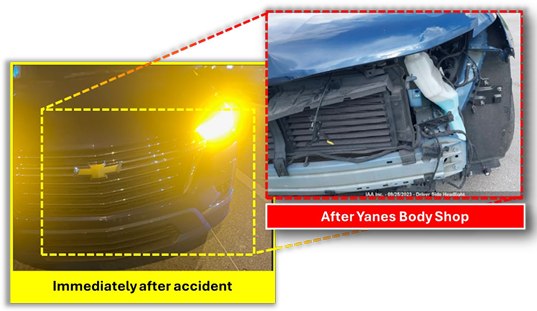
The complaint alleges a scheme in which Uber drivers were paid to stage accidents. The Uber driver’s “colliding car” would strike this “lead car” lightly from behind.47 Uber drivers were used to trigger a commercial auto liability insurance policy.48 Those involved in the staged accidents would file a false police report, with Uber drivers typically indicating they were distracted by their phones or the Uber app when they caused the crashes.49 Police reports indicated that there were no injuries, those involved refused medical treatment, and indicated only minor damage to the vehicles.50 The complaint alleges, however, that after the lead car reached one of two body shops, it was damaged further to create a false impression that these accidents resulted in serious injuries.51 In support of this assertion, the complaint includes photographs of the vehicles immediately after the accident and at the collision shop showing significantly different levels of damage.52
Claimants would then be sent to a network of medical providers to receive “a conveyor belt of medical services, receiving false diagnoses of injury, unnecessary imaging, needless and repetitive delivery of physical therapy, and expensive and unneeded pain injections.” The medical providers billed for this unnecessary care, the complaint alleges.53
According to the complaint, the law firm and attorney coordinated the claimants’ medical treatment, demanding payment for phony injuries from Uber’s insurer for as much as the full $1 million policy limits based on the “violent impact” of the crashes.54 The complaint asserts that they then filed sham lawsuits and continued to prosecute cases despite knowing or being indifferent to the fact that the claimants were not injured.
On the very same day Uber filed its action, in an unusual ruling issued sue sponte (on the court’s own initiative rather than upon a motion of a party), Chief Judge Cecilia Altonaga of the Southern District of Florida administratively closed the case to await the outcome of a motion to dismiss in Uber’s RICO action in New York against law firm Wingate, Russotti, Shapiro, Moses & Halperin, LLP.55 Judge Altonaga put the Florida case on hold because she viewed the New York case as raising “shared allegations of fraud, RICO predicate acts, and coordinated conduct (albeit with different defendants and local details).”56 A stay, the court found, would preserve judicial resources, promote consistent rulings, and avoid duplication of effort.57
As a result, the defendants have not been required to respond and, for over a year since Uber shared its allegations of a staged accident ring, the rideshare service has filed monthly status reports on its New York litigation, as the court required. After the Eastern District of New York dismissed the Wingate case in August 2026 (and the Central District of California denied a similar motion to dismiss Uber’s RICO action against the Downtown LA Law Group, see discussion pages 12-13), the court reopened the South Florida action with the defendants’ answer to the complaint due by October 13, 2026.58
Delivery Trucks Targeted in New York?
In April 2026, Federal Express filed a RICO action alleging a scheme employing low-impact accidents with its delivery trucks, which are targeted because of their predictable routes and higher commercial insurance policy limits.59 FedEx’s complaint alleges that a Brooklyn personal injury lawyer was central to this scheme, recruiting claimants to stage accidents and fabricate injuries, referring them for medical treatment, and determining when and where to file fraudulent claims.60
FedEx’s complaint explains how New York’s no-fault law incentivizes schemes of this type. Under this law, individuals in auto accidents can recover up to $50,000 for medical expenses or lost income, but cannot file a lawsuit seeking additional damages, including for pain and suffering, unless they have experienced a “serious injury.”61 According to FedEx, those involved artificially exaggerated accidents and inflated injuries through medical referrals to meet the threshold for filing lawsuits and demanding significantly higher amounts than available through the no-fault system.62 Even as Emergency Rooms detected no significant injury, and, in some cases, did not even order tests due to the minor nature of the accident, the complaint alleges claimants were immediately placed in a predetermined treatment protocol including physical therapy, chiropractic manipulation and acupuncture, injections, and, ultimately, surgeries.63 The complaint includes details, documents, and photographs related to several accidents as support for this pattern.64
In August 2026, the law firm filed a motion to dismiss the RICO claims, contending that the action is an impermissible attempt by FedEx to relitigate claims over purportedly staged accidents.65 The medical provider defendants filed their own motion to dismiss, asserting that FedEx is using “the stigmatizing effects” of a civil RICO action to deter doctors from treating and attorneys from representing injured individuals who are seeking recovery through New York’s no-fault system.66
Louisiana Actions Remain on Hold
While this paper focuses on civil RICO actions filed since 2024, two earlier claims are pending in Louisiana since 2020 and 2021, respectively.67 Both of those actions, brought by trucking companies against defendants including several attorneys, stem from a staged auto insurance ring that has led to scores of convictions in federal “Operation Sideswipe.”68 Given ongoing criminal proceedings, federal judges in the Eastern District of Louisiana stayed these claims and, this summer, denied motions to reopen them until the related criminal matters have fully concluded.69
| Filed | Court | Docket No. | Caption |
|---|---|---|---|
| 6/11/25 | S.D. Fla. | 1:25-cv-22635 | Uber Technologies, Inc. v. Law Group of South Florida, LLC, et al. |
| 4/7/26 | S.D.N.Y. | 1:26-cv-02859 | Federal Express Corp. v. Ikhilov Law Group, P.C., et al. |
| 4/14/26 | E.D.N.Y. | 2:26-cv-02195 | Uber Technologies, Inc., et al. v. Powell, et al.* |
| 6/2/26 | E.D.N.Y. | 1:26-cv-03300 | Wesco Ins. Co. v. Liakas Law, P.C., et al.70 |
* This complaint does not include a RICO claim, but alleges common law fraud, civil conspiracy, and other state law claims.
Manufactured or Exaggerated Auto Accident Injuries
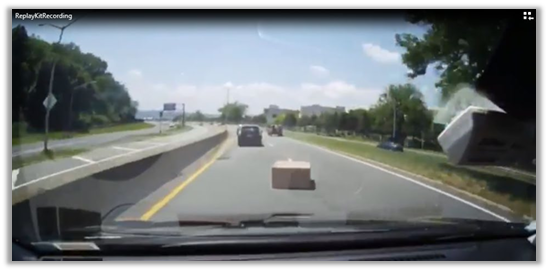
Uber has brought a series of civil RICO actions in New York, California, and Pennsylvania alleging that personal injury law firms have worked closely with medical clinics, surgery centers, and healthcare professionals to inflate the value of auto accident claims. Each action involves different defendants, though the actions make similar allegations. They generally claim that the law firms recruited individuals in purported or minor accidents (the actions do not claim accidents were staged) and referred them to medical providers who were paid to provide unsupported diagnoses and treatment recommendations. The claimants then underwent invasive and expensive procedures to inflate the claim’s settlement value, the actions claim.
“Serious Injuries” in New York?
Uber’s New York action, filed in January 2025 against three law firms including Wingate, Russotti, Shapiro, Moses & Halperin (which is facing separate RICO actions involving construction and auto accident claims discussed earlier), Banilov & Associates, and the Lavelle Law Firm, claims that the firms paid doctors above market-rate compensation to find that individuals who were uninjured or lightly injured had experienced “serious injury.”71 The law firm could then use these findings, the complaint claims, to pursue multi-million dollar claims for nonexistent injuries against Uber, including unlimited noneconomic damages, under New York law.72 Uber’s Amended Complaint documents five cases in which the alleged scheme was employed against Uber,73 as well as a dozen more cases in which the defendants “used the same illicit playbook . . . over and over again to target victims throughout New York.”74
For example, in the first incident described in the complaint, the plaintiff’s Uber driver hit a cardboard box containing a sofa cushion that had fallen out of a pickup truck.75 Cameras in the Uber vehicle capture the uneventful collision and the passenger’s talking on her phone before, during and after the incident, showing no contact, injury, or damage according to the complaint.76 Nevertheless, the complaint alleges the passenger worked with a law firm to file a fabricated claim alleging she experienced “multiple” injuries from a rear-end collision.77 The complaint alleges that she only sought treatment after the law firm she retained, Banilov & Associates, directed her to doctors, after which she underwent a regimen of acupuncture, chiropractic treatment, orthopedic surgery, pain management, and physical therapy, as well as medically unnecessary spinal injections followed by neck surgery.78
After about two and a half years of litigation, Wingate, which had later appeared for the plaintiff, filed a motion to withdraw as counsel from the $5 million lawsuit after learning of a video demonstrating that “the accident didn’t occur in the manner that the plaintiff claims it occurred, and it would be unethical for us to go forward with the case at this time.”79 According to the complaint, however, the video was an exhibit at the plaintiff’s deposition nearly a year earlier.80 The court granted the motion to withdraw and dismissed that underlying case, leaving Uber with hundreds of thousands of dollars in costs for investigating and defending against the lawsuit.81
In Uber’s RICO action, the defendants filed motions to dismiss in December 2025, with the Wingate firm charging that the lawsuit is “part of Uber’s broader strategy to flex its corporate might to intimidate personal injury attorneys who dare sue it.”82 On the same day in August 2026 that Judge Merchant dismissed Union Mutual’s RICO action against the Subin law firm stemming from allegedly staged trip-and-falls, she also dismissed Uber’s amended complaint against the Wingate firm.83 In the Uber action, the court ruled that the rideshare company’s complaint did not adequately allege a RICO enterprise, conspiracy, or injury, and entered judgment for the defendants (see discussion pages 29 to 30).84
Inflated Bills for Treatment in LA?
In July 2025, Uber filed a similar RICO complaint in California against two personal injury law firms, the Downtown LA Law Group and the Law Offices of Jacob Emrani, certain attorneys in those firms, and medical providers.85
Like many of the other RICO actions, the California suit alleges that “lawyers direct claimants to pre-selected medical providers to receive procedures for minor or nonexistent injuries.”86 The Los Angeles-area medical providers, who specialize in treating patients who have pending personal injury lawsuits, then allegedly “generate and submit artificially inflated bills for such treatment.”87 One medical provider, Uber claims, receives referrals from the law firms and then “diagnoses these claimants with serious spinal injuries, causally connects the injuries to the underlying accidents, and recommends costly surgery,” which are “not medically warranted” and performed, on lien, at inflated rates and with the understanding that if the litigation results in a shortfall, he will not pursue the patient for the balance.88 The complaint claims the medical providers and law firms use these bills “to induce significantly larger settlement payments out of Uber in personal injury lawsuits.”89
Uber is a prime target, the rideshare service contends, because California mandates rideshare companies to carry $1 million of insurance policy limits—"which are higher than those of almost every other vehicle on California roads.”90
The Downtown LA Law Group, which is caught up in separate investigation of involvement in a scheme in which individuals were paid to fabricate sexual abuse claims91 and a bar complaint alleging the firm paid an actor to pretend to be a local cowboy to sign up clients to sue about a landfill,92 calls the lawsuit “nothing more than a calculated attempt by a trillion-dollar corporation to suppress legitimate injury claims brought by rideshare passengers."93 The law firms sought dismissal, with the Downtown LA Law Group arguing that Uber is seeking to relitigate cases that it already settled with its “eyes wide open to the claims’ strengths and weaknesses.”94
In August 2026, Judge Sherilyn Peace Garnett of the U.S. District Court for the Central District of California largely denied the motions to dismiss.95 The court found that Uber had sufficiently alleged that its settlement costs in the underlying cases were “significantly higher due to the alleged fraud than they would have been without the alleged fraud” and asserted a pattern of racketeering activity involving “the same participants, victims, and methods of commission.”96 (See discussion pages 27 to 28). The court did, however, grant dismissal of Uber’s RICO conspiracy claim (with leave to amend) and awarded the defendants their attorneys fees stemming from Uber’s voluntary dismissal of state law claims following the defendants’ filing a motion under California’s anti-SLAPP statute.97
Lawyers Allegedly Scheduled Patient Treatment in Philadelphia Cases
Uber also filed a RICO action in federal court in Pennsylvania in which it was later joined by FedEx in suing a local personal injury law firm, claiming that it “orchestrat[ed]” an “industrial-scale litigation fraud scheme,”98 in which it transforms otherwise marginal claims into “million-dollar-plus lawsuits” to drive inflated settlement demands.99 This case is particularly significant in that it is the first of these recent actions in which a court has found that the plaintiffs have sufficiently alleged a RICO claim, allowing the action to move forward.
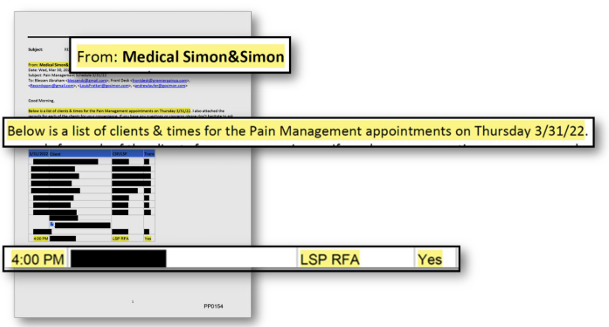
That RICO action focuses on Simon & Simon, which markets itself as “known throughout Philadelphia [as] the Auto Accident law firm.”100 Other defendants include healthcare providers associated with a pain and rehab center, chiropractic practice, and orthopedic practice to which the law firm referred its clients.101 The Amended Complaint, filed in January 2026, alleges that the law firm “direct[ed] their clients to a network of corrupt medical providers who diagnose non-existent serious injuries, deliver unnecessary medical treatment, and produce false medical records to support claims that the claimant will require a lifetime of expensive medical care.”102
In this instance, Uber and FedEx claim that the law firm itself would schedule groups of clients to be seen at a particular doctor’s clinic “in bulk,” even instructing the doctor “on the purported treatment to be administered” and specific times to administer procedures on specific patients.103 The complaint claims the firm would directly compensate the doctor “as a bribe” and then use the false records as the “foundation for exorbitant projections of future required medical treatment” that would often not be delivered because they are not needed.104 Likewise, the complaint alleges that law firm steered its clients for chiropractic treatments, some of which were not performed at all, to generate false diagnoses and records “for the purpose of artificially inflating damages claims.”105 As a final step, the complaint alleges that the firm sent clients to another doctor who would generate a false report indicating that the patient will “require a lifetime of expensive ongoing care” which these individuals acknowledged they never received.106 The complaint also claims that Simon & Simon relies on referrals of cases from other firms involving “minimal, if any, injury” that would ordinarily “be resolved through an administrative no-fault process or would not be brought at all.”107
| Filed | Court | Docket No. | Caption |
|---|---|---|---|
| 1/30/25 | E.D.N.Y. | 1:25-cv-00522 | Uber Technologies, Inc. v. Wingate, Russotti, Shapiro, Moses & Halperin, LLP, et al. |
| 7/1/25 | C.D. Cal. | 2:25-cv-06612 | Uber Technologies, Inc. v. Downtown Law Group, et al. |
| 9/18/25 | E.D. Pa. | 2:25-cv-05365 | Uber Technologies, Inc. and Federal Express Corp. v. Simon & Simon P.C., et al. |
When Uber sought to question the key doctor in the underlying actions, the lawyers, “quickly dismissed Uber from each of the then-pending nearly thirty cases” involving that doctor to “avoid discovery and conceal the scheme” while continuing to pursue the same actions against other defendants,” the complaint claims.108 The Amended Complaint includes examples of this alleged pattern involving Uber, FedEx, and others.109
The district court denied motions to dismiss filed by the attorney and doctor defendants in May 2026,110 allowing the suit to move forward and setting an important precedent for civil RICO actions (see full discussion, pages 25 to 26).
And, in August 2026, the court dismissed counterclaims filed by the lawyers alleging that, by filing civil RICO actions, Uber and FedEx have engaged in “sham litigation, abuse of process, and extortion.”111 It similarly dismissed counterclaims filed by some of the doctors alleging that Uber’s alleged involvement in the media’s coverage of the racketeering accusations amounted to defamation and “false light invasion of privacy.” As the court observed:
We appreciate experienced personal injury lawyers and doctors do not like reading their names in federal court complaints alleging their specific roles in alleged racketeering conduct. Especially when those allegations are made by companies Uber and FedEx whom they often sue in Philadelphia County seeking to recover for alleged personal injury losses subject to the state court judge’s and jury’s scrutiny. And then these allegations show up in press reports.112
The court concluded, however, that neither the lawyers nor the doctors had plead facts supporting their counterclaims. The court reaffirmed that “after oral argument and extensive analysis detailed in a fifty-four page opinion . . . we already found the companies pleaded the detail necessary to proceed on their racketeering claims.”113
Undeterred, one week after the court denied its counterclaims, Simon & Simon filed a motion asking the court to dismiss Uber’s RICO claims primarily on the basis that the rideshare company had not experienced an injury, and lacked standing to sue, because its insurer had covered the allegedly inflated personal injury settlements.114 That motion for is pending. The court has set a December 9, 2026, deadline for parties to file motions for summary judgment.
Other Contexts
Asbestos Litigation: Law Firms Allegedly Coached Witnesses to Identify Targeted Companies
Unlike the auto accident-related cases discussed above, RICO actions stemming from asbestos litigation allege that plaintiffs’ firms coached clients and manipulated evidence to pursue solvent companies for settlement money, regardless of whether those businesses caused the claimed injuries. These complaints therefore test whether RICO may reach alleged fraud occurring within mass tort litigation rather than traditional insurance fraud.
J-M Manufacturing Company (“J-M”) has sued the two most prolific filers of asbestos lawsuits in the nation, Simmons Hanly Conroy LLP and The Gori Firm, claiming, in separate RICO actions, that the firms brought hundreds of “sham lawsuits” against the company to extract settlements.118
J-M makes plastic pipe and, for five years in the 1980s, produced a limited amount of asbestos-cement pipe that water districts needed as they transitioned to PVC. Because the asbestos was encapsulated and the pipe was designed not to require cutting or drilling, workers faced little risk of exposure. After the primary manufacturers and distributors of friable asbestos products declared bankruptcy, however, J-M became a target. Since 2000, J-M has been named in more than 6,000 asbestos cases, typically by people with mesothelioma.119
In the first action, J-M alleges that Simmons Hanly filed more than 430 asbestos claims against J-M since 2001.120 The company claims it settled more than 75 of those lawsuits based on “falsehoods” presented by the firm.121 What the complaint characterizes as the law firm’s “playbook” included offering perjured testimony and suppressing evidence of their clients’ exposure to asbestos from bankrupt companies, to extract settlements from solvent companies including J-M.122 The complaint alleges that the firm coached clients into giving “nearly uniform” testimony, following a script, about how they came into contact with asbestos-cement pipes “without regard for the actual facts of usage and exposure.”123 When claims against J-M were exposed as baseless, the law firm would voluntarily dismiss the claim as part of a settlement of another firm matter or to avoid exposure of the fraud, according to the complaint.124
A federal court in Illinois initially dismissed J-M’s RICO action against the Simmons firm, finding the complaint insufficiently alleged an illicit enterprise beyond the law firm and its employees.125 The court has since permitted J-M to file an amended complaint,126 which adds a law firm that gathers and refers asbestos claims to Simmons Hanly.127 It claims that Massachusetts-based Sokolove Law holds itself out as a “national law firm,” but is in, in reality, a lead generator that “fuel[s] Simmons Hanley’s pattern of fraudulent litigation.”128 A motion to dismiss is pending, with a lawyer for the Simmons firm contending it “is substantially the same as the complaint already dismissed.”129
A few months after filing the amended complaint in the Simmons Hanly case, J-M filed a similar RICO action against The Gori Law Firm, the top filer of asbestos lawsuits in the nation for the past decade.130 According to the complaint, the 45-attorney firm filed nearly 5,000 lawsuits since 2018, more than 400 of which named J-M as a defendant.131 The firm filed nearly all of these cases in Madison and St. Clair counties in Illinois – “cherry-picked jurisdictions” that it views as most favorable and unlikely to impose sanctions – when most of its clients live in other states and there is no real connection to Illinois.132 The Complaint alleges:
Of the approximately 434 cases the Gori Firm has filed against J-M Manufacturing since 2018, approximately 418 have been dismissed—a 96.3% dismissal rate. This extraordinary dismissal rate, unprecedented in legitimate litigation, demonstrates that the overwhelming majority of filings had no realistic prospect of success . . . . While none of the cases against J-M Manufacturing ever went to trial, the Gori Firm nevertheless caused J-M Manufacturing to spend vast sums of litigation fees and expenses defending against these claims.133
J-M claims that it learned of the details of the strategy the Gori Law Firm uses from a whistleblower, an attorney who conducted client depositions, from 2018 to 2024.134 According to the complaint, deposition attorneys received a low base salary, but could earn hundreds of thousands of dollars each year if they successfully coached their clients to testify that they were exposed to products on the firm’s “bounty list”—solvent defendants, including J-M, who were perceived as “easy” targets willing to settle for substantial sums.135 When attorneys met with a sick, often hospitalized elderly client who could not recall what products they were exposed to decades ago, they were trained to provide a product list and instruct them to testify at the deposition that they came up with the list themselves.136 The firm then sued the maximum number of solvent defendants as possible, 60 companies on average per case, to maximize settlements, the complaint alleges.137
According to the complaint, The Gori Law Firm used a “batch settlement strategy” in which it would settle groups of cases in exchange for dropping manufactured cases that it knew were objectively baseless, viewing those cases as “bargaining chips.” 138
The Gori Law Firm filed a motion to dismiss in April 2026, characterizing J-M’s lawsuit as “premised on underlying asbestos litigation that it did not win, chose not to litigate, and settled.”139 It charged that J-M had resorted to a “thermonuclear device” in an attempt to “chill its litigation adversaries” from representing people who are dying from a deadly cancer.140 The firm claims it has immunity for litigation-related activities, in addition to contending that J-M has failed to adequately allege a RICO enterprise.141 The court held a hearing on the motion to dismiss on July 15, 2026, but has not yet ruled.
If substantiated, these allegations represent one of the more detailed attempts to describe an internal litigation-management system designed to generate settlement leverage through volume rather than claim merit.
Product Liability: “Cookie-Cutter Complaints” Against Protective Equipment Maker
RICO actions have expanded beyond asbestos litigation into other occupational disease claims.
In June 2025, respirator manufacturer 3M filed a 114-page RICO action against three attorneys in separate law firms in three different states stemming from asbestos claims they filed in Kentucky state courts.142 According to the amended complaint, the attorneys allegedly solicited coal miners to file “cookie-cutter complaints” blaming 3M’s respirators for their black lung disease diagnoses and injuries.143 Ultimately, the attorneys filed more than 850 claims against 3M, over half of which were filed during just eighteen months, and which, the complaint alleges, included “claims Defendants knew were fraudulent.”144 According to the complaint, the attorneys filed and litigated these claims in “at least 22 separate complaints containing nearly identical allegations, language, and structure.”145
The RICO action claims that the attorneys targeted 3M, not because faulty dust masks caused their clients’ injuries, but because compensation from mine operators and other sources dried up.146 The attorneys could recover contingency-fees on fraudulent claims that settled, or, if suspicions arose, use those claims as “bargaining chips” to be dismissed in settlement negotiations, the complaint alleges.147 The lawsuits were designed, the complaint alleges, “to exert maximum power on 3M to settle the entire inventory of cases—including claims Defendants knew were fraudulent—at a huge sum.”148
One of the attorneys involved responded by calling the RICO action a “transparent and desperate attempt to intimidate our firm and silence legitimate legal advocacy on behalf of individuals harmed by 3M’s conduct.”149 Meanwhile, 3M has claimed that one of the lawyers involved may have moved and hidden the original case files in a storage unit to avoid discovery and sought a protective order.150 A federal court in Kentucky granted that motion, finding “real danger” of evidence destruction.151 The court has not ruled on motions to dismiss that have been pending since October 2025 and has stayed discovery.152
In opposition to the motions to dismiss, in August 2026, 3M filed material with the court alleging that 45% of the lawsuits the three attorneys had filed against 3M claiming black lung injuries in 2021 were “threadbare” and “so patently frivolous” that the court dismissed them without “plaintiffs even attempting to offer any support for their claims.”153 As for the remaining claims, 3M indicated that it had already filed, and was continuing to file, summary judgment motions “premised on the complete lack of evidence” supporting them.154 The 3M filing asserts that “Defendants’ claims were objectively baseless from their inception, and Defendants knew it.”155
California’s Lemon Law: Fictitious Records for Attorneys’ Fees
California’s Lemon Law litigation presents a different theory of RICO liability. Rather than alleging fabricated injuries or fraudulent medical or exposure evidence, Ford Motor Company contends that plaintiffs’ attorneys systematically inflated fee petitions submitted after what may be otherwise legitimate consumer warranty litigation.
California’s unique Song-Beverly Consumer Warranty Act, known as the “Lemon Law,” was designed to protect consumers who purchase or lease defective vehicles, but has become a cash-cow for lawyers. The Lemon Law allows drivers to seek a refund or replacement of a new car that has had mechanical problems if the manufacturer or dealer cannot fix it after a reasonable number of attempts. If the driver is not satisfied, they can sue – and not only can they sue – they can collect their attorneys’ fees on top. As California attorneys have taken advantage of this law, Lemon Law claims exploded from about 4,500 in 2015 to roughly 30,000 in 2024,156 and, despite legislative efforts to rein them in, were on pace to hit 38,000 in 2025, according to the latest statistics available.157
In May 2025, Ford filed a civil RICO action accusing California attorneys of churning out fictitious billing records in thousands of lemon law claims.158 According to the most recent complaint, which narrowed the defendants to three partners at the Knight Law Group LLP, Ford claims that it paid at least $100 million based on “sham billing records,” including by attorneys who purportedly billed more than 24 hours per day (as much as 57.5 hours) or simultaneously attended different trials or depositions in distant jurisdictions.159 The attorneys avoided detection, the complaint contends, by “spreading their fictitious billing records across numerous matters involving different California courts, cases, and auto manufacturer defendants.”160 Their clients, Ford alleges, were also duped, because the lawyers included provisions in their retainer agreements that penalized clients who attempted to settle their own claims before their attorneys could run up the bills, and demanded that automakers pay fees months, or even more than a year, after their clients’ claims were resolved.161
After nearly a year of litigation, a federal court dismissed Ford’s RICO claim.162 Judge Michelle Wiilliams Court ruled that the law firms and attorneys involved are immune from liability under the Noerr-Pennington doctrine, a First Amendment doctrine that immunizes parties from liability over protected activities involving petitioning the government. The fee petitions, the court found, were protective petitioning activity, regardless of whether the lawyers demanded fees from the automakers or directly petitioned the court. And, while there is a “sham litigation” exception to the doctrine, the court found it did not apply because the fee demands, even if fraudulent, did not render the lemon law claims themselves “illegitimate.” Finally, the court found Ford did not adequately allege that the lawyers and firms constituted an “enterprise” formed for the purpose of fraudulent billings rather than simply bringing lemon law cases. Ford has appealed the dismissal to the Ninth Circuit,163 with Ford’s in-house counsel commenting that “if the district court’s opinion is to stand, then it means that there is no civil remedy when lawyers lie, cheat and steal as long as such behavior is done in furtherance of litigation.”164
Meanwhile, Ford has filed a similar lawsuit against another law firm, but opted not to rely on RICO.165 In June 2026, Ford sued Quill & Arrow, alleging that the Los Angeles law firm inflated its bills in Lemon Law claims by as much as 7,000% by using an “army” of non-lawyers, including foreign contractors, who were paid as little as $13 per hour to help file thousands of Lemon Law claims.166 The suit contends, the firm pretended that California attorneys, billing as much as $950 per hour, did the work.167 Characterizing the law firm as a “fraudulent and illegal billing factory,” the complaint also alleges that those involved engaged in manufactured and prolonged litigation, rejecting Ford’s invitations to promptly repurchase the vehicle that would have benefited their clients, to run up fees.168 In that case, however, Ford relies on a California law that provides a civil action for theft, which, like RICO, allows for treble damages, and includes claim under the state’s consumer protection law.169 The law firm’s motion to dismiss is pending.170
Class Action Litigation: Manufactured or Real?
Civil RICO actions may also provide a means for businesses to respond when attorneys or serial plaintiffs repeatedly file baseless or manufactured class actions, expecting that some businesses will settle regardless of the merits given the risk involved. Thus far, it appears that only one recent complaint attempts to use RICO in this manner, though a targeted business recently alleged fraud when seeking denial of class certification and dismissal.
A relatively small number of attorneys have filed hundreds of very similar complaints against businesses, settling some cases on an individual basis for their nuisance value while others are dismissed.171 Rarely do courts sanction such conduct, though the Eleventh Circuit recently affirmed a lower court’s decision to award attorneys’ fees to a retailer to partially cover the cost of responding to a class action that the company’s lawyers described as fitting a “pattern of bringing frivolous lawsuits in courts around the country.”172
Now, three restaurants with common ownership have filed a RICO action in response to what they allege is a frivolous class action lawsuit. They allege that a New York attorney, C.L. Lee, turned a former employee’s termination into a complex wage-and-hour class action lawsuit to extort a settlement. Lee is known as a prolific filer of consumer class action lawsuits in New York,173 and, the complaint alleges, claims to be “approved as class counsel in over 100 wage class actions.”174 The underlying lawsuit stems from an individual hired as a chef by a Long Island Mexican restaurant, Bongo Burrito, and let go after less than one month because, according to the RICO action, he did not work out.175
| Context | Principal Allegation | Representative Plaintiffs | State |
|---|---|---|---|
| Construction sites | Staged accidents | Reinsurers Insurers | NY |
| Trip-and-falls | Staged accidents, unnecessary treatment or fraudulent medical expenses | Insurers | NY |
| Auto accidents | Staged accidents, fake or exaggerated injuries, unnecessary treatment or fraudulent medical expenses | Insurers Uber FedEx | CA, FL, PA, NY |
| Occupational injuries | Manipulated or false exposure or product use testimony | J-M Mfg. Co. 3M Co. | IL, KY |
| Lemon Law claims | Inflated attorney fee petitions | Ford Motor Co. | CA |
| Class actions | Manufactured class allegations | Wicked Taco | NY |
The RICO complaint claims that the attorney transformed the employee’s termination into a labor law class action by coaching employees of a commonly owned Italian restaurant on the same block, Charred, to indicate in sworn declarations and deposition testimony that the restaurants operated as an integrated enterprise, routinely sharing employees and supplies.176 “The problem,” the RICO complaint alleges, is that three of the four employees worked at and departed Charred before Bongo Burrito even opened for business.177 The RICO action alleges that only C.K. Lee, as an experienced wage and hour attorney, could have influenced them to make such false statements.178 By taking this approach, the complaint contends the attorney turned the dispute into a complex lawsuit based on perjured facts to raise the costs and stakes of the litigation and pressure the restaurants into a settlement.179 The relatively short RICO complaint is pending (as is the underlying litigation), with the docket indicating that the attorney plans to file a motion to dismiss.
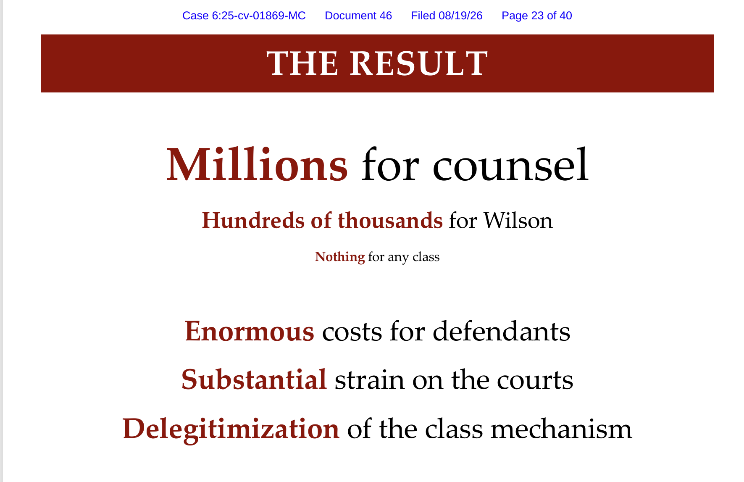
Meanwhile, in an Oregon federal court, a defendant refused to allow voluntary dismissal of what it views as a baseless class action and has, instead, alleged fraud.180 Freeway Insurance Services insists, in responding to a lawsuit brought under the Telephone Consumer Protection Act (TCPA), that it did not send unsolicited text messages to the plaintiff, Chet Wilson, but responded to a rate quote inquiry submitted with his phone number.181 According to the insurer, Wilson has 83 TCPA class actions in less than two years and has never recovered anything for class members.182
In seeking denial of class certification, the insurer not only charged that Wilson has systematically abused the class action mechanism, but that a law firm operating as a “lead generator” is behind this and other similar cases and profiting from them.183 Rather than allow the attorneys who received the referral to abandon their client’s claims, leaving the defendant with substantial costs, the insurer subpoenaed that firm, the Heidarpour Law Firm, and demanded that Wilson dismiss all his pending TCPA cases and pay the insurer’s attorneys’ fees.184 In response, the plaintiff called the fraud charge “speculation stacked on speculation.”185 The Heidarpour firm retained a prominent attorney who has asked the court to quash the subpoena as seeking privileged information and award the firm its fees for responding to the insurer’s “hyperaggressive litigation positions.”186
Following a hearing, the court granted the insurer’s motion to deny class certification, denied the plaintiff’s motion for dismissal, ordered the plaintiff and the Heidarpour Law Firm to preserve all electronic devices and communications regarding TCPA actions, and indicated it may take further action to investigate the allegations.187
While not a RICO action, the Freeway Insurance case is an example of a class action defendant refusing to enter what it views as an extortionate settlement demand and a court not permitting plaintiffs’ attorneys to walk away from a potentially fraudulent class action that provides no benefit to consumers.
The Role of Litigation Funding
A New York Times expose recently reported that the growth of litigation funding has coincided with an explosion of personal injury cases, including lawsuits “commonly seek[ing] seven-figure payouts for construction accidents, car crashes and slip-and-falls.”188 Funders say they level the playing field by enabling injured people to take on insurers and other powerful adversaries. Other say, and evidence suggests, however, that outside investment in litigation fuels demand for more claims with higher damages by an industry that is not bound by legal ethics and “just simply want to make money off the justice system.”189 The major funders of cash advances to plaintiffs securitize their I.O.U.s, the New York Times found, and the “ecosystem” that has resulted facilitates the fraud that has led insurers and others to turn to civil racketeering actions.
“This ecosystem was built one lawsuit at a time: Funding companies market their services directly to consumers and deploy sales reps to cultivate relationships with lawyers. Lawyers often connect their clients with funders, which provide cash advances and then bundle them.
As the number of personal injury cases has climbed, government officials and the insurance industry have warned about increasing and even systemic fraud — raising questions about whether fraud is seeping into securities.”
New York Times, 8/18/26
| Filed | Court | Docket No. | Caption | Context |
|---|---|---|---|---|
| 1/4/24 | E.D. Pa. | 2:24-cv-00026 | Murtaugh v. Goggin, et al. | Litigation Funding for Personal Injury Claims |
| 5/10/24 | N.D. Ill. | 1:24-cv-03853 | J-M Mfg. Co. v. Simmons Hanly Conroy, LLP, et al. | Product Liability: Asbestos Litigation |
| 6/3/25 | E.D. Ky. | 6:26-cv-00034 7:25-cv-00037 | 3M Co. v. Hammon et al. | Product Liability: Respirators |
| 1/28/26 | S.D. Ill. | 3:26-cv-00094 | J-M Mfg. Co. v. The Gori Law Firm, et al. | Product Liability: Asbestos Litigation |
| 2/10/26 | E.D.N.Y. | 2:26-cv-00767 | Wicked Taco LLC v. C.K. Lee | Class Action Litigation |
| 5/21/26 | C.D. Cal. | 2:25-cv-04550 | Ford Motor Co. v. Knight Law Group LLP, et al. | California Lemon Law |
| 6/12/26 | S.D.N.Y. | 1:26-cv-05006 | New York Marine & Gen. Ins. Co. v. Case Cash Funding, LLC, et al. | Litigation Funding for Personal Injury Claims |
| 6/18/26 | C.D. Cal. | 2:26-cv-06614 | Ford Motor Co. v. Quill & Arrow LLP* | California Lemon Law |
* Does not include a RICO claim but invokes a similar California statute.
Several RICO complaints stemming from staged accidents or exaggerated injuries allege that litigation funders provided the capital necessary to recruit vulnerable low-income claimants with upfront cash and compel their cooperation contingent on future payments, and pay for unnecessary treatment and surgeries, in exchange for a substantial portion of the expected settlement. In some instances, the funders are named as defendants in the lawsuits.190 Other complaints name the funders as “John Does,” a placeholder until those involved are revealed through discovery.191 In some complaints, litigation funders are not defendants but are alleged to have played a part in the scheme.192 These allegations are particularly concerning because they suggest the emergence of a financial infrastructure capable of underwriting and scaling questionable litigation practices.
A few RICO cases have focused squarely on litigation funding, rather than a funder’s involvement in a broader scheme. An example, filed in June 2026, is New York Marine & General Insurance Company’s lawsuit against Case Cash Funding and its principal, Gregory Elefterakis, who is described in the complaint as a suspended attorney.193 According to the insurer’s complaint, the lender and its owner allegedly pay questionable medical clinics for referrals, steer claimants – who are often non-English speaking with little education – to “beholden attorneys” who are financially dependent on the lender, provide loans to pay for medically unnecessary surgeries at usurious rates, and exercise veto power over settlements.194 While the complaint does not name any attorneys or law firms as defendants, it indicates that Case Cash’s receivables were concentrated among just three law firms and refers to other pending RICO actions against law firms.195
Lawsuits also allege that law firms have misused litigation funding to overcharge their clients. For example, in Pennsylvania, a law firm’s client used RICO to sue his former attorney and a litigation funder after he received less than a third of a $475,000 settlement of his workplace injury case.196 The client claimed that the attorney convinced him to take a series of payments totaling $33,060 from the lender, then the attorney used his case as collateral to secure about $71,000 in litigation funding.197 When the case settled, the attorney tacked on repayment of the loans with exorbitant interest to the bill.198 The complaint alleged that, based on language in the funding agreement that indicated the funder entered it based on its “confidence in current counsel,” the defendants likely engaged in the same conduct with other clients.199
In March 2025, a federal court denied the defendants’ motion to dismiss, finding the plaintiff alleged “an association-in-fact enterprise between the defendants,” including “unauthorized, secret funding agreements that the enterprise used to defraud him” and “multiple acts of ongoing racketeering activity.”200 A few months after that ruling, the parties stipulated to dismissal of the case.201 While it is unclear whether the case ultimately settled, the court’s ruling suggests that questionable alliances between lawyers and funders may give rise to viable civil RICO claims.
No-Fault Schemes Centering on Clinics, Pharmacies & Medical Equipment Suppliers
A review of court dockets also revealed 299 RICO claims filed between January 1, 2024 and August 31, 2026 – not including attorney defendants – that allege that fraud rings, usually led by medical clinics, medical equipment suppliers, or pharmacies and their owners, rack up charges for unnecessary treatment, testing, or mobility aids or, in some cases, for care or products that were never provided, then submit those claims to auto insurers for payment. This is a far greater number than has been reported in the media.202
Civil RICO complaints alleging auto insurance fraud, not including attorney defendants
Filed 1/1/24 – 8/31/26 · 299 total
Four out of five of these auto insurer RICO actions respond to alleged fraud under New York’s no-fault law, which requires a person’s own insurer to pay up to $50,000 for necessary medical, surgical, or rehabilitation expenses stemming from accidents.203 New York regulations allow insureds to assign their statutory benefits to licensed health care providers in exchange for services, and the providers in turn can submit claims directly to the insurance company.204 As a result, insurance companies will often pay medical service providers directly for the treatment they provide to automobile accident victims without the need to bill the victims themselves. Unfortunately, a tremendous number of people appear to have taken advantage of this system, which is intended to quickly compensate those who have experienced relatively minor injuries in auto accidents without the need to decide who was at fault. Insurers filed just over 100 of these actions in each of 2024 and 2025, though, at the current pace, the full 2026 tally is expected to approach 140.
Based on the sheer number and steady flow of RICO claims, the Eastern District of New York may deserve the title, “America’s auto insurance fraud court.” Insurers have also brought a significant number of RICO actions alleging no-fault auto insurance fraud schemes in Florida and Michigan.
The allegations underlying these auto insurance RICO actions are troubling. At their core, they allege classic insurance fraud schemes including false claims, overbilling, or providing unnecessary treatment or medical equipment. They involve claims for benefits that were not filed in court and do not allege that attorneys or law firms knowingly participated in schemes. In these actions, insurers attempt to claw back money paid on these fraudulent claims and seek a declaration from the court that they are not obligated to pay pending claims from these providers.
Based on the sheer number and steady flow of RICO claims, the Eastern District of New York may deserve the title, “America’s auto insurance fraud court.”
Significant Court Rulings
Because most of the litigation discussed in this paper remains in its early stages, relatively few courts have addressed the merits of these latest RICO actions. The decisions issued thus far, however, offer several principles and identify recurring questions that are likely to shape future litigation.
Early court rulings indicate that some courts are receptive to these claims—the most significant development to date is a ruling permitting a RICO action brought by Uber and FedEx to move forward in Pennsylvania. Yet, other court rulings suggest that businesses and insurers face significant challenges when relying on RICO to respond to concerns about fraudulent claims and abusive litigation practices.
Federal Courts Can Stop Fraudulent Litigation in State Court
In 2024, the U.S. Court of Appeals for the Second Circuit ruled that not only could a RICO action brought by an insurer alleging fraudulent no-fault claims move forward, but that federal courts can enjoin litigation in state courts and arbitration proceedings tainted by that alleged fraud.205
In State Farm Mutual Automobile Insurance Co. v. Tri-Borough NY Medical Practice P.C., State Farm alleged that medical clinics and healthcare professionals had demanded that the insurer pay for medical treatment provided under New York’s no-fault law that was unnecessary and based on predetermined protocols.206 When the insurer denied claims, those involved would allegedly bring arbitration actions and lawsuits in state court. At the time of the decision, the defendants had brought approximately 480 lawsuits in state court and over 2,450 arbitrations.207
The Second Circuit recognized that state court proceedings can “themselves [be] part of a pattern of baseless, repetitive claims that are being used” to further a federal RICO violation.208 The appellate court also observed that “state courts are unlikely to even recognize the alleged massive RICO scheme” because they decide individual claims, which “obscures the overall complex scheme.”209 The Second Circuit viewed civil RICO not merely as a damages remedy but also as a vehicle allowing federal courts to evaluate allegations that could not realistically be assessed in “piecemeal” state proceedings.210
The Tri-Borough decision, which the Second Circuit reaffirmed in GEICO v. Patel in 2026,211 is often cited in RICO complaints. Federal district courts have relied upon the ruling to stay pending and future no-fault insurance collection arbitration proceedings and state court actions commenced against insurers by medical providers during pending RICO litigation.212
Attorneys Are Not Immune from RICO Claims
While the Tri-Borough case did not include attorney defendants, a federal district court in Pennsylvania recently permitted Uber’s and FedEx’s RICO action against a local personal injury law firm to proceed (discussed pages 13 to 14), rejecting common arguments for dismissal seen in these actions.213
The court did not find the defendants’ Noerr-Pennington arguments persuasive. Judge Mark A. Kearney of the Eastern District of Pennsylvania held that while filing complaints seeking recovery for clients that have experienced personal injuries is “classic petitioning activity,” the doctrine does not shield lawyers from RICO claims when there is a “pattern or practice of successive fraudulent filings undertaking to harass and extract settlement value through the process of litigation.”214
A central feature of the May 2026 opinion is its distinction between protected petitioning activity and allegedly fraudulent conduct occurring before litigation begins. Judge Kearney emphasized that directing medical treatment, recruiting claimants, and creating allegedly false evidence precede any petition to the courts and therefore do not necessarily receive constitutional protection.215 That conduct, the court found, was not merely “incidental” to petitioning the government, it occurred outside the litigation process and involved third parties.216 The court would not interpret the Noerr-Pennington doctrine to grant broad immunity to “virtually all prelitigation activity . . . simply because a lawsuit follows.”217
Even if the Noerr-Pennington doctrine applies, the court held that the complaint plausibly alleged that the lawyers and doctors engaged in “a pattern of litigation aimed at obtaining settlements rather than securing relief based on the underlying merits,” which fulfills the doctrine’s “sham litigation” exception.218 Judge Kearney also dispensed with the lawyers’ and doctors’ argument that the “sham litigation exception” to the doctrine does not apply because the “core” of the underlying claims (that clients were injured by negligence in auto accidents) was legitimate and not invalidated by allegations that they engaged in conduct that “at most inflate the extent of injury.”219 But Uber and FedEx had alleged far more, the court found, including conduct that went to the heart of the “existence, cause, and medical necessity of the claimed injuries” and whether, absent the misrepresentations, the claims would have been filed at all.220
Critically, Judge Kearney rejected the proposition that, because the parties had settled some of the claims, they could not be considered “objectively baseless.”221 Rather, the court recognized that parties may settle cases based on “litigation costs or reliance on allegedly fabricated evidence.”222
In addition, the court found that res judicata does not bar RICO claims alleging fraud in concluded litigation, as the lawyers and doctors were not parties to those cases and those personal injury claims are fundamentally different than racketeering allegations.223
Finally, Judge Kearney found that the “exhaustive detailed allegations” plausibly pled the elements of a civil RICO action. The court found the complaint adequately alleged predicate acts (“repeated use of the mail and interstate wires to transmit fraudulent records”;224 an “enterprise” consisting of multiple independent actors whose relationship extended beyond “mere referral relationships” (coordination among participants in furtherance of “a shared purpose [of] manufacturing fraudulent evidence of accident-induced serious injuries” to enable lawyers “to extract inflated settlement” over several years);225 proximate causation of injury to their business or property needed for standing (incurring defense costs and relying on misrepresentations to pay inflated settlements);226 and a conspiracy (“coordinated participation in a shared scheme rather than isolated professional services or unrelated parallel conduct”).227
The court concluded that “a lawyer and his experts cannot create false documents under the guise of the Petition Clause and then be immune for their fraud.”228 Uber and FedEx, Judge Kearney found, would now be permitted to conduct discovery to produce evidence supporting their allegations and, if they sufficiently do so, would have an opportunity to present their case to a jury.229
Injury & Causation is “Straightforward”
The Central District of California applied similar reasoning in denying defendants’ motions to dismiss Uber’s RICO action alleging that two law firms and a spine center made false and misleading statements concerning the severity of their clients’ injuries, the necessity of medical treatment, and the nature of lien agreements.230
Judge Garnett found that Uber’s allegations satisfied the “sham litigation exception” to the Noerr-Pennington doctrine.231 The court observed that “while it is true that the Plaintiff does not challenge whether the underlying accidents occurred”:
“[F]raudulent statements about the injuries, and about the causal connection between the accidents and the injuries, go to the very heart of the litigation. These facts impact whether the Claimants had claims at all, whether the claims would be brought in a court of law, and whether Plaintiff could be considered liable for the claims.”232
The complaint sufficiently alleged not only that the defendants made misrepresentations in demand letters and through other pre-litigation conduct, but also in complaints and other documents filed with the courts.233 The allegations, the court found, involve more than “simply inflat[ing] estimates of damages” but “affect both the fact and extent of injury” as well as causation.234
Judge Garnett rejected the notion that because the underlying actions ended in final judgments or settlement agreements, “claim preclusion” did not allow Uber to challenge their legitimacy through a civil RICO action. That doctrine, the court found, only precludes further litigation between the same parties, and the law firms named in the RICO suit were not parties in the personal injury litigation, regardless of whether they represented clients in those actions.235 Nor did settlement agreements in those actions have effect anyone beyond the parties.236 The fact that Uber had made the calculation to settle individual personal injury lawsuits, the court recognized, does not mean it could not bring a RICO claim in which “it is permitted to aggregate evidence from multiple cases.”237
Finding Noerr-Pennington immunity did not apply, the court turned to whether Uber’s complaint sufficiently stated a RICO claim. With respect to whether Uber had adequately alleged a RICO “enterprise,” the court found that “Plaintiff has plausibly alleged that the relationship here is more than a routine commercial relationship between a personal injury law firm and a spine surgeon.”238 “These allegations of purposeful direction of the means, nature, and financing of claimants’ medical treatment go beyond a typical arm’s length business relationship.”239 The specific allegations and documentation submitted along with the complaint “suggest that Defendants acted not pursuant to an ordinary business relationship but in furtherance of a ‘common purpose’ of generating inflated medical bills to extract higher settlements from Plaintiff.”240 The complaint, the court found, sufficiently alleged defendants had engaged in a pattern of racketeering activity.
Finally, the court found Uber’s theory of proximate causation for its injuries “straightforward”:
“Defendants’ fraudulent claims of injury, causation, and damages inflated the settlement value of the Claimants’ claims, causing Plaintiff to incur higher settlement costs than it otherwise would have. There is nothing “remote” about this chain of causation. First, Plaintiff is the most “direct” victim of the alleged wrongful conduct. . . . Second, while there may be some difficulty in ascertaining the amount of damages, courts “distinguish between certainty in the fact of damages and in the amount of damage.”241
The court did grant the defendants’ motion to dismiss a separate RICO conspiracy claim. It found the complaint lacked factual allegations linking the two law firm defendants through an agreement, as opposed to separate enterprises consisting of each law firm and the same medical providers.242 The court provided that Uber may file an amended complaint to address the deficiency in its conspiracy claim by September 30, 2026, or litigation will proceed on the other RICO claims.
Challenges for Businesses
In contrast to Eastern District of Pennsylvania and Central District of California decisions, some courts have dismissed civil RICO actions brought by businesses and insurers alleging fraudulent claim schemes. Plaintiffs in these actions have experienced a series of adverse rulings in New York.
RICO standing / causation
Federal courts in New York have dismissed a series of cases filed by reinsurers finding they lack statutory standing to bring RICO actions because they are “[m]ultiple steps’ away from the alleged fraud” and their injuries are “too attenuated to survive dismissal.”243 In July 2026, the Second Circuit affirmed dismissal in one such case, Roosevelt Road Re, Ltd. v. Subin.244
The Second Circuit’s ruling came in the context of a RICO action alleging that personal injury lawyers recruited construction workers to stage construction accidents and then filed bogus workers’ compensation claims and lawsuits. The appellate court found that reinsurer was unable to plead that it was directly injured by the alleged fraud. Rather, the reinsurer’s claimed losses stemmed from their complex contractual arrangements that put them on the hook for harms to third parties, the court found.245 This was not enough to satisfy RICO’s requirement that a private party bringing an action have experienced an injury “by reason of” racketeering activity.246 While the appellate court found the complaint alleged a “disturbing pattern of fraud,” it ruled that “by design, RICO’s direct-relationship requirement constrains civil RICO claims and may present an insurmountable obstacle even to parties that have suffered real harms.”247
The Second Circuit reached this conclusion in a nonprecedential summary order. Nevertheless, absent Supreme Court intervention, it may spell the end of civil RICO cases filed by reinsurers in that jurisdiction. Language in the ruling also calls into question the ability of primary insurers to bring similar claims, though, importantly, the court recognized that “[t]his calculus might change, of course, if the insurer were the direct target of the fraud,”248 as is the situation in RICO actions alleging fraudulent no-fault claims (and both the precedential Tri-Borough and Patel cases). The outcome of the appeal should also have no bearing on the ability of businesses who allege losses from fraudulent lawsuits against them to pursue civil RICO actions.
Nevertheless, in two August 2026 rulings, Judge Orelia Merchant of the Eastern District of New York dismissed separate RICO actions filed by Union Mutual Fire Insurance Company, a primary insurer, and Uber, a direct defendant, finding they failed to allege a sufficiently direct injury to satisfy statutory standing. In Union Mutual action, the insurer had claimed that law firms, runners, medical clinics, doctors, and lawsuit lenders participated in a scheme that involved staging a fall, overtreating, and suing.249 The court ruled that as an insurer for the property owners, Union Mutual was “at least two steps beyond the alleged racketeering activity.”250 The claimants in the allegedly fraudulent suits may have been directly harmed by the “usurious” loans for medical treatment or unnecessary surgeries, the court found.251 And the allegedly fraudulent lawsuits may have directly injured the property owners, who were the named defendants.252 But an insurer—even one with a legal duty to defend its insureds—cannot show sufficient directness of the conduct and the harm to establish causation, the court held (while distinguishing no-fault claims).253 In addition, the court ruled that to the extent a RICO action is rooted in pending litigation, it cannot establish “clear and definite” damages caused by a violation. 254
Would Uber then, a named defendant in allegedly fraudulent accident claims, be able to meet the RICO standing threshold? There too, Judge Merchant said no. While the court’s dismissal in that instance focused on whether Uber sufficiently alleged an “enterprise” (discussed below), the court also found that Uber failed to assert a “clear and definite injury.”255 The court reasoned that several of the case examples Uber had relied upon were still pending, leaving its injury uncertain, and the few cited cases that had concluded were insufficient to establish a pattern.256 Uber’s claims were “unripe.”257
Noerr-Pennington immunity
While Judge Kearney (E.D. Pa.) and Judge Garnett (C.D. Cal.) rejected application of the Noerr-Pennington immunity to RICO claims alleging fraudulent litigation, businesses and insurers may still face challenges in other courts. As discussed earlier, a federal court in California dismissed Ford’s RICO claim alleging that attorneys inflated their fees associated with Lemon Law litigation. It found attorney conduct in filing claims shielded them from liability under the Noerr-Pennington doctrine and that the “sham litigation” exception did not apply because the underlying claims were legitimate even if the associated bills were not. That court also recognized that it remains to be seen whether this ruling will withstand Ninth Circuit review.258
Alleging and defining the RICO enterprise
Businesses and insurers face challenges in sufficiently establishing a RICO “enterprise.” In the Ford Lemon Law case, the California court ruled that the automaker had not sufficiently alleged that the attorneys and firms involved are a RICO “enterprise” because their purpose was to litigate, not fraudulently bill.259 Similarly, a federal court in Illinois ruled that pipe maker J-M’s complaint alleging that the Simmons Hanly firm engaged in baseless asbestos litigation against the company to extract settlements failed to sufficiently allege an illicit enterprise beyond the law firm and its employees.260 That court has not yet ruled on a motion to dismiss the company’s amended complaint, which adds as a defendant a second law firm that served as a referral source for clients for these claims.261
By way of contrast, in Uber’s New York case, the rideshare company had detailed relationships between multiple law firms and medical practices, but the court found the complaint did not sufficiently allege they had a common purpose “to carry out their bribery and fraud scheme targeting Uber.”262 The court found that “at best” the facts alleged in the complaint indicated that the doctors “received benefits incidental to an ordinary and lawful client-referral relationship and third-party litigation financing of medical treatment.”263 Nor did referral and fee-sharing relationships between the two law firm defendants raise a plausible inference of illegal conduct.264 And the law firms’ relationships with certain doctors, the court found, did not “suggest anything more than routine medical referrals and medical declarations.”265 The court concluded that rather than establish that the many sets of defendants acted with a common purpose, the complaint’s allegations “support only an inference of independent relationships” in which “different sets of Defendants” engaged in “different schemes” to “allegedly defraud Uber in a variety of ways.”266 The court declined to connect these dots, finding the allegations showed only shared business and referral relationships and “acted for their own business interests.”267 The complaint did not adequately allege that the defendants had “all agreed to join forces with each other” to pursue a common goal or commit predicate acts.268
Impact of settlements
At least one court has ruled that settling the underlying cases can break the causation chain and preclude RICO recovery. In that instance, insurers brought an action against chiropractors and physicians who owned and operated clinics and rehabilitation centers that allegedly submitted false medical records for care related to auto accident patients. Judge Kenneth Hoyt of the Southern District of Texas reasoned that because insurers “negotiated what they apparently believed to be a fair and reasonable settlement with the Insureds attorneys,” who were not alleged to be part of the scheme, “[t]the settlement resolved the Insureds; claims, interrupting the alleged fraud or wrongdoing on the part of the defendants.” Since the insurers “freely engaged in settlement discussions and reached amicable resolutions,” the court found, “they cannot rethink or recalculate in order to obtain a different result.”269 The court’s reasoning is not only in tension with the Uber ruling in Pennsylvania but seems to overlook that the insurers may have entered the settlements by accepting the truth of allegedly fraudulent documents or negotiating from a false baseline calculation of damages.
Uncertain application and judicial hesitance
Courts have shown hesitance in applying the strong medicine of a RICO action to personal injury attorneys. For example, as discussed, a federal court in Florida has, for over one year, stayed Uber’s RICO claims stemming from allegations of staged accidents in the Miami-Dade County area as it awaits guidance from a ruling on still-pending motions to dismiss in an Uber case alleging that a different law firm sought settlements for exaggerated injuries or unnecessary treatment stemming from motor vehicle accidents in New York City.270 This stay remains in place even after the federal court in Pennsylvania allowed Uber’s claims there to move forward.
Although the jurisprudence remains in its infancy, several tentative conclusions emerge. Courts appear most receptive to claims alleging fraudulent conduct occurring outside the judicial process, particularly where plaintiffs allege extensive coordination among attorneys, recruiters, medical providers, and other participants. Courts appear least receptive to RICO claims brought by organizations, such as reinsurers, whose losses stemming from the alleged fraudulent claim schemes are viewed as indirect. At the same time, courts continue to scrutinize statutory standing even in cases brought by primary insurers and individual businesses, the enterprise requirement, the impact of settlements, and the interaction between civil RICO and the Noerr-Pennington doctrine. The contours of these claims will continue to be shaped the ongoing litigation.
Solutions
The growing use of civil RICO in response to alleged litigation fraud raises a broader institutional question: why are businesses and insurers turning to a statute designed to combat organized criminal enterprises rather than relying on traditional safeguards embedded within the civil justice system? The complaints and decisions discussed in this paper suggest several possible explanations, including the perceived limitations of sanctions procedures, disciplinary systems, fraud investigations, and existing civil remedies. Courts, legislatures, regulators, and prosecutors can address these gaps.
Address Frivolous or Fraudulent Personal Injury Actions During the Litigation
Rules of civil procedure provide that, by signing a complaint, an attorney represents that he or she has conducted a reasonable investigation of the allegations and determined they have factual support.271 In addition, the attorney certifies that the complaint is not presented for an improper purpose, such as to harass or needlessly increase the cost of litigation.272
Courts should provide defense counsel with adequate flexibility to investigate suspicious claims, medical treatment, or bills through discovery. Courts should also be receptive to requests from defendants in personal injury litigation to file amended answers or assert counterclaims, even late in the case, when a business or insurer believes it has uncovered evidence of fraud. For example, in a 2023 New York case in which two plaintiffs allegedly denied any injuries at the accident scene but went on to have a series of surgeries and physical therapy far from home, the trucking company recently filed a third-party complaint against the doctors and medical practices involved, alleging fraud, aiding and abetting fraud, and deceptive practices.273
In addition, given their obligation to verify the factual basis of complaints before filing them, attorneys should not be able to hide behind referral sources and dismiss or withdraw from those cases without penalty when questions arise, leaving businesses and insurers shouldering the cost of investigating and defending each case.
Courts should carefully scrutinize an attorney’s or law firm’s repeated voluntary dismissal of claims or request to withdraw as counsel when the surrounding circumstances suggest a pattern of filing unsupported actions and abandoning them before judicial review.274 When warranted, courts should impose sanctions such as awarding a business the expenses it incurred as a direct result of a frivolous or fraudulent claim or referring the attorney involved to the bar for further inquiry and potential disciplinary action.
And when evidence indicates that a party has participated in criminal behavior, the court should refer the matter to the proper authorities. As Justice Salvatore J. Modica of the New York Supreme Court, Queens County, observed, in a case in which an affidavit submitted to the court indicated that three individuals involved in an accident had set out together “hoping in particular to find a bus and some ‘deep pocket’ defendant or insurer”:
“[I]n the experience of the undersigned, even when judges are handed the details of criminal behavior as they arise in civil cases, whether involving forgeries or outright theft from honest and hard-working consumers, courts, whether out of tired indifference or outright cynicism, do not either bother to inform prosecutors or make a recommendation of criminal investigation. A judicial shrugging of the shoulders in the face of criminality—if proven—is just unacceptable. When courts start looking the other way when given details of insurance fraud or scams on innocent consumers then they have effectively enabled and facilitated the wrongdoing and illegality to blossom, thrive, and prosper. This is unacceptable. It is cold indifference by those with a responsibility to act in the face of overt illegality that allows such criminality to flourish. If wrongdoing can be established, the failure of overburdened insurers, jaded prosecutors, and cynical judges to take action is wrong. Certainly, judges, sworn to uphold the law, cannot invoke ostrich-like blindness or escapism.”275
Strengthen Rules Intended to Prevent Frivolous Claims
Ideally, the same court rules should provide a mechanism for courts to respond to frivolous or fraudulent lawsuits. But those rules often include hurdles that make it challenging for a defendant to recover costs incurred as a direct result of lawsuit abuse.
For example, the federal approach, which many states follow, provides a safe harbor allowing attorneys to withdraw frivolous claims without penalty if they do so within 21-days of a defendant drafting and sharing, but not actually filing, a motion for sanctions.276 In addition, the rules authorize courts to award as a monetary sanction no more than the minimum amount “warranted for effective deterrence,” regardless of how much a defendant has spent defending against a frivolous claim.277
Some states have additional constraints. For instance, New York, a state that otherwise allows unlimited damages for tort claims, protects lawyers who injure others by capping sanctions for frivolous claims at no more than $10,000 “for any single occurrence of frivolous conduct.”278
The free pass to file and withdraw frivolous lawsuits provided by safe harbor rules should be eliminated and courts should be permitted to order full reimbursement of the cost of responding to a frivolous (or fraudulent) lawsuit.
Closely and Fairly Consider Civil RICO and Fraud Actions
In some instances, even strong sanctions rules may be inadequate to address alleged misconduct that spans numerous cases, multiple courts, and many participants. When courts receive well-pleaded civil RICO complaints supported by detailed factual allegations, they should evaluate those claims under ordinary RICO principles rather than dismiss them simply because they arise from litigation.
Businesses and insurers that believe they have been defrauded also have other options beyond RICO claims. They can file statutory or common law fraud claims. For instance, an insurer of a construction company recently filed a civil action alleging that a claimant executed a power of attorney with a law firm and a litigation funding agreement weeks before an unwitnessed fall at a construction site.279 The complaint claims the law firm then booked that client for spinal surgery, knee surgery, and rehabilitation despite presenting at the hospital with so much as “a scratch, a bump, or a bruise.”280 Rather than use RICO, the insurer alleged claims under a New York statute that prohibits attorneys from engaging in “deceit or collusion” and the New Jersey Insurance Fraud Prevention Act, both of which subject violators to treble damages.281 As noted earlier, Ford has pursued litigation both under RICO and a similar California law as well as consumer protection claim.282
Attorneys and law firms raise similar defenses in response to these alternative claims. For example, in another New York action in which an insurer alleges that attorneys engaged in “deceit or collusion” by funneling clients to “a clinic formed and staffed by a litigation funder” and an attorney for “surgery-friendly MRIs,”283 the defendants claim the complaint merely “pleads disagreement with litigation positions, medical causation theories, expert medical opinions, and the prosecution of contested personal injury claims,” involving ordinary referral practices, “not actionable deceit.”284
Law firms should not be viewed as categorically immune from the same laws that apply to similar schemes involving clinics, medical professionals, and others. As the Eastern District of Pennsylvania found, the Noerr-Pennington doctrine should not extend beyond courthouse filings to activities such as recruiting claimants and sending them to clinics to document fake injuries or for unnecessary treatment to fuel settlement demands.285 Courts should provide businesses and insurers with an opportunity to prove their cases.
Mass Tort Litigation Reforms
Courts can strengthen verification requirements for mass tort claims, where there is an incentive for lead generators, runners, and litigation funders to recruit as many claims as possible, and for attorneys to participate or look the other way when some of these claims are meritless or even fraudulent. For example, some judges overseeing mass tort litigation have adopted early vetting requirements that require claimants to make a basic initial showing that they used the product or service and experienced the type of injury at issue in the litigation when filing a complaint.286 This approach can help prevent stockpiling of cases gathered from aggressive advertising and recruitment by lead generators and batch or global settlement strategies that package potentially valid cases with frivolous or fraudulent ones.
Legislative Interventions
Lawmakers can enact legislation to prevent and deter fraud and improve transparency and accountability, addressing concerns raised in RICO suits. For example:
- In 2026, New York enacted some of the measures Governor Hochul proposed to address rampant auto insurance fraud in the Empire State, including subjecting those who orchestrate staged accidents, beyond the participants, to criminal prosecution, and reducing subjectivity in determining whether a person has experienced a “serious injury” in an accident permitting a tort claim.287
- Eight states have enacted “over-naming laws” that prevent lawyers from naming scores of companies as defendants in asbestos litigation unless they can show the client used that company’s product.288
- A growing number of states have enacted laws regulating litigation funding practices and requiring disclosure of funding arrangements.289 Some states have also enacted legislation addressing arrangements in which medical clinics provide treatment to personal injury plaintiffs with the expectation that they will be paid at inflated rates out of the expected recovery.290 These laws can shine sunlight on predatory arrangements that are used to finance claimant recruitment and medical treatment.
- Federal legislation known as the Staged Accident Fraud Prevention Act would subject any person who stages or helps stage an accident with a commercial motor vehicle to up to 20 years in prison. If the staged accident results in a serious injury, participants would face a minimum 20-year sentence.291
Criminal Enforcement
Many of the complaints discussed in this paper contain allegations, documentary evidence, testimony, communications, and patterns spanning years and hundreds of claims. Some of the RICO actions include allegations against overlapping individuals and firms. Given the detail and scope of the allegations described in these complaints, appropriate investigative authorities may wish to determine whether further review is warranted.
Federal prosecutors, state attorneys general, and district attorneys occasionally prosecute no-fault and other insurance fraud committed by sham medical clinics and those who owned or controlled them,292 and sometimes the attorneys involved in these schemes.293 Newsday recently reported that the Brooklyn District Attorney’s Office has opened a criminal investigation connected to RICO complaints alleging fraudulent accident schemes.294 And, when announcing that two men had received prison sentences for insurance fraud for orchestrating staged accidents on a New York highway, Queens District Attorney Melinda Katz indicated a wider ongoing investigation into the “ecosystem of profit.” “Today is not only about these cases, today is a warning shot to all of the doctors, the medical facilities, the lawyers, to anyone who are involved in these insurance schemes,” Katz said. “We are going to look for you, we are going to find you, and we are going to prosecute you for these crimes.”295
Nevertheless, prosecutors may be hesitant to bring actions against attorneys who take an oath to uphold the law and may claim to be no more than an unwitting participant. Investigative authorities should determine whether the allegations in the civil RICO complaints are unsupported accusations—as the law firms often contend—or if there is evidence of unlawful conduct.
Conclusion
The allegations in these civil RICO actions paint a troubling picture. Across multiple jurisdictions, businesses and insurers increasingly claim they are confronting not isolated fraudulent claims, but coordinated enterprises involving lawyers, medical providers, runners, lead generators, litigation funders, and others who allegedly profit from manufacturing lawsuits, inflating damages, or otherwise manipulating litigation. Whether these allegations ultimately prove true or are merely an intimidation tactic, as attorneys representing those sued typically contend, remains for courts and juries to decide.
What is already clear, however, is that businesses and insurers are increasingly turning to a statute enacted to combat organized crime because they view traditional safeguards as inadequate. That reality alone should concern courts, policymakers, regulators, disciplinary authorities, and prosecutors.
Courts should give defendants in personal injury litigation adequate leeway to investigate suspected fraud through discovery and seek recovery. They should also permit well-pleaded RICO actions alleging litigation fraud schemes to proceed. Legislatures should strengthen deterrents against fraudulent claims and abusive litigation practices. Prosecutors should investigate credible allegations. And attorney disciplinary authorities should ensure that those who abuse the civil justice system are held accountable.
The costs associated with allegedly fraudulent litigation are borne not only by those who face these lawsuits. The substantial amounts spent on these claims are passed onto drivers, homeowners, and businesses in the price they pay for insurance. Consumers also experience the effects when for a ride or delivery, or even their rent.296 Taxpayers shoulder a burden too, as fraudulent claims increase costs for public projects, like constructing schools.297 While the precise economic impact is difficult to quantify, the allegations underscore that litigation-related fraud imposes significant costs on the public.
Public confidence in the civil justice system depends on the principle that legal claims are based on genuine injuries supported by truthful evidence. When that principle is undermined, the consequences extend beyond individual defendants and insurers to every person and business that depends on a fair, honest, and reliable system of civil justice.
Endnotes
Show all 297 endnotesHide endnotes
- Emily Cousins, Insurers Pursue RICO Case Against Lawyers, Litigation Funders and Medical Providers, Law.com, Nov. 14, 2025 (quoting attorney Eric Subin). ↩
- 18 U.S.C. § 1962(c), (d). ↩
- 18 U.S.C. § 1964(c). ↩
- Medical Marijuana Inc. v. Horn, 604 U.S. 593, 612-13 (2025) (citing Sedima, S.P.R.L. v. Imrex Co., 473 U.S. 479, 499 (1985)). ↩
- See id. ↩
- ATRA joined an amicus brief expressing concern that permitting RICO plaintiffs to recover damages flowing from personal injuries, rather than to “business or property,” could result expansion of RICO claims into garden-variety tort litigation. Brief for the Chamber of Commerce of the United States of America, Product Liability Advisory Council, and American Tort Reform Association Supporting Petitioners, Medical Marijuana Inc. v. Horn, No. 23-365 (U.S. filed July 16, 2024). While the principal dissent agreed with these concerns, the majority emphasized that RICO’s constraints should avoid such expansive application. See 604 U.S. at 612-13. ↩
- See David Thomas & Mike Scarcella, RICO Gets a Workout in Spate of Cases Against Injury Lawyers, Reuters, June 18, 2026. ↩
- 18 U.S.C. § 1962(c). ↩
- 18 U.S.C. § 1961(1). ↩
- Agency Holding Corp. v. Malley-Duff & Assocs., Inc., 483 U.S. 143, 156 (1987) (finding 15 U.S.C. § 15b applies to RICO actions); see also Rotella v. Wood, 528 U.S. 549, 555 (2000) (considering application of a discovery rule in civil RICO claims). ↩
- 18 U.S.C. § 1961(5). ↩
- Fed. R. Civ. P. 8. ↩
- Fed. R. Civ. P. 9. ↩
- See Kristin Thorne, Fake Construction Falls in NY Contributing to Rise in Rent, Home Costs, Eyewitness News ABC7, Nov. 7, 2023. ↩
- Kristin Thorne, Law Firm Seeks to Walk Away from Hundreds of Lawsuits After Eyewitness News Investigation, Eyewitness News ABC7, Sept. 6, 2024. ↩
- Kristin Thorne, 7OYS Investigation Finds Dozens of Injury Lawsuits from People Living in Same Apartment Buildings, Eyewitness News ABC7, Oct. 4, 2024. ↩
- Id. ↩
- Id. ↩
- Ionian Re, LLC v. Gorayeb & Associates, P.C., No. 1:24-cv-07098 (E.D.N.Y. filed Oct. 10, 2024) (dismissed without prejudice, motion for leave to amend filed May 15, 2026) ↩
- Ionian Re, LLC, Skyline Restoration Inc., Urban D.C., and DNA Contracting & Waterproofing LLC v. Cedillo, No. 1:24-cv-07969 (E.D.N.Y. filed Nov. 15, 2024) (motions to dismiss pending). ↩
- Greater New York Mut. Ins. Co. v. Subin Assocs., LLP, No. 1:26-cv-00470 (E.D.N.Y. filed Jan. 27, 2026); Merchants Mut. Ins. Co. v. William Schwitzer & Assocs., P.C., No. 1:25-cv-05859 (E.D.N.Y. filed Oct. 20, 2025). ↩
- Roosevelt Road Re, Ltd. v. Wingate, Russotti, Shapiro, Moses & Halperin, No. 1:24-cv-06259 (E.D.N.Y. Sept. 29, 2026); Roosevelt Road Re, Ltd. v. Haggar, No. 24-cv-01549 (E.D.N.Y. Mar. 11, 2026) (Gorayeb & Associates, P.C. complaint); Roosevelt Road Re, Ltd. v. William Schwitzer & Assocs., P.C., No. 25-cv-03386 (E.D.N.Y. Feb. 18, 2026); Roosevelt Road Re, Ltd. v. Subin, No. 24-cv-05033, 2025 WL 1713109, at *8 (E.D.N.Y. June 19, 2025). ↩
- Roosevelt Road Re, Ltd. v. Subin, No. 25-2560, 2026 WL 2108399 (2d Cir. July 22, 2026). ↩
- Memorandum of Law in Support of Defendants Liakas Law, P.C. and Dean N. Liakas’ Motion for Sanctions, Roosevelt Road Re, Ltd. v. Liakas Law, P.C., No. 1:25-cv-00300 (E.D.N.Y. filed May 6, 2026). ↩
- See, e.g., Robert Brodsky, Lawsuit: Long Islanders Participated in Alleged Fraud Scheme to Stage Fake Accidents, Newsday, May 12, 2025 (reporting on RICO suit filed by Union Mutual Fire Insurance Company against the Liakas law firm and as well as a orthopedics practice, regional hospital, radiology firms, a pain management and rehabilitation center, physicians, and a lawsuit lender). ↩
- Id. (interviewing Long Island-attorney Dan Johnston). ↩
- Kristin Thorne, How Fake Slip-and-fall Claims Can Lead to Rising Rent, Homeowner Costs, Eyewitness News ABC7, Aug. 1, 2024. ↩
- See id. ↩
- Complaint ¶¶ 60, 107, Wesco Ins. Co. v. Liakas Law, P.C., et al., No. 1:26-cv-03300 (E.D.N.Y. filed June 2, 2026). ↩
- Id. ¶ 104. ↩
- Id. ¶ 61. ↩
- Id. ¶¶ 35, 66, 102. ↩
- Id. ¶¶ 108-109, 445. ↩
- Id. ¶ 59. ↩
- Id. ¶ 75. ↩
- Id. ¶ 82. ↩
- Amended Complaint, Union Mut. Fire Ins. Co. v. Subin Assocs., LLP, No. 25-cv-02652 (E.D.N.Y. filed Aug. 13, 2025). ↩
- Id. ¶¶ 115, 156, 228. ↩
- See id. ¶¶ 168-69. ↩
- See id. ¶¶ 171, 194-206. ↩
- See id. ¶ 198 (emphasis in original). ↩
- Memorandum & Order, Union Mut. Fire Ins. Co. v. Subin Assocs., LLP, No. 25-cv-02652 (E.D.N.Y. Aug. 14, 2026). ↩
- Id. at 14. ↩
- Id. at 16. ↩
- See id. at 17-19. ↩
- Complaint, Uber Technologies, Inc. v. Law Group of S. Fla., LLC, No. 25-cv-22635 (S.D. Fla. filed June 11, 2025). ↩
- Id. ¶ 29. ↩
- Id. ¶ 30. ↩
- Id. ¶ 31. ↩
- Id. ¶¶ 52, 72, 97, 118, 141. ↩
- Id. ¶ 30. ↩
- Id. at 13, 23, 32, 42. ↩
- Id. ¶ 2. ↩
- See id. ¶ 9, 65, 66, 68, 87, 88, 132, 147; see also Elizabeth Daley, Uber Says Fla. Firm, Drivers Staged Wrecks for Profit, Law360, June 11, 2025. ↩
- Order Administratively Closing Case, Uber Technologies, Inc. v. Law Group of S. Fla., LLC, No. 25-cv-22635 (S.D. Fla. June 11, 2025). ↩
- Id. at 2. ↩
- Id. ↩
- See Order, Uber Technologies, Inc. v. Law Group of S. Fla., LLC, No. 25-cv-22635 (S.D. Fla. Sept. 21, 2026); see also Plaintiff's Status Update, Uber Technologies, Inc. v. Law Group of S. Fla., LLC, No. 25-cv-22635 (S.D. Fla. filed Aug. 21, 2026). ↩
- Complaint at ¶¶ 3, 81, Federal Express Corp. v. Ikhilov Law Group, P.C., No. 1:26-cv-02859 (S.D.N.Y. filed Apr. 7, 2026). ↩
- Id. ¶¶ 4, 12-15, 19. ↩
- Id. ¶¶ 82-84 (discussing N.Y. Ins. Law § 5102(d)). ↩
- Id. ¶ 86. ↩
- Id. ¶ 87. ↩
- Id. at 26-67; see also Hope Patti, FedEx Says NY Attys and Medical Providers Staged Crashes, Law360, Apr. 8, 2026. ↩
- Memorandum of Law in Support of the Ikhilov Defendants’ Motion to Dismiss, at 7, Federal Express Corp. v. Ikhilov Law Group, P.C., No. 1:26-cv-02859 (S.D.N.Y. filed Aug. 31, 2026). ↩
- Medical Defendants’ Joint Memorandum of Law in Support of Motion to Dismiss, at 1, Federal Express Corp. v. Ikhilov Law Group, P.C., No. 1:26-cv-02859 (S.D.N.Y. filed Aug. 31, 2026). ↩
- See Complaint, C.R. England Inc. v. Giles et al., No. 2:21-cv-00264 (E.D. La. filed Feb. 9, 2021) (civil RICO action brought by trucking company against three attorneys, law firm, and several other individuals allegedly involved in staged accidents); Complaint, Southern Motor Freight, Inc. v. Keating et al., No. 2:20-cv-02398 (E.D. La. filed Sept. 1, 2020) (civil RICO action brought by trucking company against two attorneys based on allegations in criminal indictments that indicated they had participated in a staged accident scheme). ↩
- See New Orleans Attorneys Found Guilty in Plot to Stage Vehicle Accidents for Payouts, The Guardian, Mar. 20, 2026. ↩
- Order, C.R. England Inc. v. Giles et al., No. 2:21-cv-00264 (E.D. La. June 10, 2026) (administratively closing case subject to right of any party to reopen at the conclusion of the parallel criminal matter); Order, Southern Motor Freight, Inc. v. Keating et al., No. 2:20-cv-02398 (E.D. La. filed June 9, 2026) (denying unopposed motion without prejudice given possibility of ongoing proceedings related to sentencing or appeals). ↩
- While the AmTrust action against Liakas Law focuses on staged trip-and-fall accidents, it also alleges staged auto accidents. See Complaint, at ¶ 60, Wesco Ins. Co. v. Liakas Law, P.C., et al., No. 1:26-cv-03300 (E.D.N.Y. June 2, 2026). ↩
- Complaint, at ¶ 23, Uber Technologies, Inc. v. Wingate, Russotti, Shapiro, Moses & Halperin, LLP, et al., No. 1:25-cv-00522 (E.D.N.Y. filed Jan. 30, 2025). ↩
- Id. ↩
- Amended Complaint ¶¶ 35-139, Uber Technologies, Inc. v. Wingate, Russotti, Shapiro, Moses & Halperin, LLP, et al., No. 1:25-cv-00522 (E.D.N.Y. filed July 23, 2025). ↩
- Id. ¶¶ 140-276. ↩
- Id. ¶ 35. ↩
- See id. ¶¶ 35-38. ↩
- Id. ¶¶ 40, 60-61. ↩
- Id. ¶¶ 41-55. ↩
- Id. ¶ 77. ↩
- Id. ↩
- Id. ¶¶ 78-79. ↩
- Memorandum of Law in Support of Wingate Defendants’ Motion to Dismiss, Uber Technologies, Inc. v. Wingate, Russotti, Shapiro, Moses & Halperin, LLP, et al., No. 1:25-cv-00522 (E.D.N.Y. filed Dec. 12, 2025). ↩
- Memorandum & Order, Uber Technologies v. Wingate, Russotti, Shapiro, Moses & Halperin, LLP, et al., No. 1:25-cv-00522 (E.D.N.Y. filed Aug. 14, 2026). ↩
- Id. at 7, 25. ↩
- Complaint, Uber Technologies, Inc. v. Downtown LA Law Group, No. 2:25-cv-06612 (C.D. Cal. filed July 21, 2025). ↩
- First Amended Complaint, at ¶ 2, Uber Technologies, Inc. v. Downtown LA Law Group, No. 2:25-cv-06612 (C.D. Cal. filed Dec. 19, 2025). ↩
- Id. ↩
- Id. at ¶¶ 11, 52-55. ↩
- Id. ¶ 12. ↩
- Id. ¶ 8. ↩
- See Rebecca Ellis, L.A. County D.A. Claims Four in Five Cases in $4-billion Sex Abuse Payout May be Fraudulent, L.A. Times, June 11, 2026; Rebecca Ellis, State Bar Investigating Law Firm at Center of L.A. County’s $4-billion Sex Abuse Settlement, L.A. Times, Jan. 21, 2026; Rebecca Ellis, In the Biggest Sex Abuse Settlement in U.S. History, Some Claim They Were Paid to Sue, L.A. Times, Oct. 2, 2025; see also Amanda Bronstad, 'Do I Close My Eyes?' Los Angeles Judge Grills Lawyers in $4B Sex Abuse Settlement Over DA's Fraud Claims, The Recorder, June 15, 2026. ↩
- Rebecca Ellis, Cowboys, Margaritas and Toxic Trash: Some Sour on Lawyers in Lucrative L.A. Landfill Cases, L.A. Times, July 12, 2026. ↩
- Rose Krebs, Uber Sues LA Law Firms Over Alleged Crash Fraud Scheme, Law360, July 21, 2025. ↩
- Downtown LA Law Group’s Notice of Motion and Motion to Dismiss, at 1, Uber Technologies, Inc. v. Downtown LA Law Group, No. 2:25-cv-06612 (C.D. Cal. filed Jan. 23, 2026); see also Rose Krebs, Uber’s Fraud Claims Against LA Firms is ‘Fantasy,” Court Told, Law360, Nov. 17, 2025. ↩
- Order Granting, In Part, and Denying, In Part, Defendants’ Motions to Dismiss Plaintiff’s First Amended Complaint and Granting Defendants’ Motions for Attorney’s Fees, Uber Technologies, Inc. v. Downtown LA Law Group, No. 2:25:cv-06612 (C.D. Cal. Aug. 19, 2026). ↩
- Id. at 78, 80. ↩
- See id. at 33, 84-85. ↩
- Memorandum of Law in Support of Plaintiffs’ Motion to Dismiss the Counterclaims of Defendants Simon & Simon, P.C. and Marc Simon, Uber Technologies, Inc. and Federal Express Corp. v. Simon & Simon P.C., et al., No. 2:25-cv-05365 (E.D. Pa. filed June 29, 2026). ↩
- First Amended Complaint, ¶¶ 95-97, Uber Technologies, Inc. and Federal Express Corp. v. Simon & Simon P.C., et al., No. 2:25-cv-05365 (E.D. Pa. filed Jan. 26, 2026); see also Complaint, Uber Technologies, Inc. v. Simon & Simon P.C., et al., No. 2:25-cv-05365 (E.D. Pa. filed Sept. 18, 2025). ↩
- Simon & Simon, PC Injury Lawyers, https://www.gosimon.com/practice-areas/ (last visited Sept. 22, 2026). ↩
- See First Amended Complaint, Uber Technologies, Inc. and Federal Express Corp. v. Simon & Simon P.C., et al., No. 2:25-cv-05365 (E.D. Pa. filed Jan. 26, 2026). ↩
- First Amended Complaint ¶ 5. ↩
- Id. ¶ 6. ↩
- Id. ¶ 7. ↩
- Id. ¶ 8. ↩
- Id. ¶ 9. ↩
- Id. ¶ 33. ↩
- Id. ¶¶ 99, 115-17, 135-37. ↩
- Id. at 29-103. ↩
- Uber Technologies, Inc. v. Simon & Simon P.C., No. 2:25-cv-05365, 2026 WL 1284178 (E.D. Pa. May 11, 2026). ↩
- Defendants/Counterclaimants Simon & Simon, P.C., and Marc Simon’s Answer, Affirmative Defenses and Counterclaims, at 5, Uber Technologies, Inc. and Federal Express Corp. v. Simon & Simon P.C., et al., No. 2:25-cv-05365 (E.D. Pa. filed June 8, 2026). ↩
- Memorandum, at 1, Uber Technologies, Inc. and Federal Express Corp. v. Simon & Simon P.C., et al., No. 2:25-cv-05365 (E.D. Pa. Aug. 27, 2026). ↩
- Id. at 1-2; see also James Boyle, Uber Beats Defamation Claims in Philly RICO Fight, Law360, Aug. 27, 2026, ↩
- Defendants Simon & Simon, P.C. and March Simon’s Memorandum of Laws in Support of Their Motion for Partial Summary Judgment on RICO Standing Against Uber Technologies, Inc., Uber Technologies, Inc. and Federal Express Corp. v. Simon & Simon P.C., et al., No. 2:25-cv-05365 (E.D. Pa. filed Sept. 2, 2026); see also James Boyle, Philly Firm Says Recent Discovery Dooms Uber’s RICO Suit, Law360, Sept. 3, 2026. ↩
- CSX Transp. Inc. v. Peirce, 974 F. Supp.2d 927 (N.D. W. Va. Sept. 25, 2013); see also Daniel Fisher, Law Firm Hit With $429,000 Verdict Over Faked Asbestos Suits, Forbes, Dec. 21, 2012. ↩
- CSX Transp. Inc. v. Peirce, No. 5:05-cv-00202, 2013 WL 5375950, at *1 (N.D. W. Va. Sept. 25, 2013). ↩
- See Peter Vieth, $7.3M Asbestos Fraud Settlement Ends 4th Circuit Appeal, Va. Lawyers Weekly, Nov. 6, 2014. ↩
- Complaint, J-M Mfg. Co. v. Simmons Hanly Conroy, LLP, No. 1:24-cv-03853 (N.D. Ill. filed May 10, 2024) (“Simmons Complaint”); Complaint, J-M Mfg. Co. v. The Gori Law Firm, No. 3:26-cv-00094 (S.D. Ill. filed Jan. 28, 2026) (“Gori Complaint”). ↩
- Simmons Complaint at ¶ 50. ↩
- Id. at ¶ 11. ↩
- Id. ↩
- Id. ¶ 71. ↩
- Id. ¶¶ 152-55. ↩
- Id. ¶ 10; see also id. ¶¶ 114, 133, 142, 171 (providing examples of dismissed cases); Jack Karp, ‘Prolific’ Asbestos Injury Firm Accused of Fraud, Racketeering, Law360, May 13, 2024. ↩
- Memorandum Opinion and Order, J-M Mfg. Co. v. Simmons Hanly Conroy, LLP, No. 1:24-cv-03853, at 10-19 (N.D. Ill. Mar. 18, 2025). ↩
- Memorandum Opinion and Order, J-M Mfg. Co. v. Simmons Hanly Conroy, LLP, No. 1:24-cv-03853, at 12-13 (N.D. Ill. Sept. 17, 2025). ↩
- Amended Complaint, J-M Mfg. Co. v. Simmons Hanly Conroy, LLP, No. 1:24-cv-03853 (N.D. Ill. Nov. 11, 2025); see also Emily Field, Pipe Maker Names 2nd Firm in Asbestos RICO Suit, Law360, Nov. 13, 2025. ↩
- Id. ¶¶ 4, 76-86. ↩
- David Thomas & Mike Scarcella, RICO Gets a Workout in Spate of Cases Against Injury Lawyers, Reuters, June 18, 2026. ↩
- Gori Complaint ¶ 3. ↩
- Id. ¶ 4. ↩
- Id. ¶¶ 4, 47. ↩
- Id. ¶¶ 4-5. ↩
- Id. ¶ 35. ↩
- Id. ¶¶ 36-39. ↩
- Id. ¶ 44. ↩
- Id. ¶ 46. ↩
- Id. ¶¶ 53-55. ↩
- Memorandum of Law in Support of Defendants’ Motion to Dismiss Plaintiff’s Complaint, J-M Mfg. Co. v. The Gori Law Firm, No. 3:26-cv-00094, at 1 (S.D. Ill. filed Apr. 21, 2026). ↩
- Id. ↩
- See id. at 2, 10-16. ↩
- See Amended Complaint, 3M Co. v. Hammond, No. 7:25-cv-00037, ¶¶ 2, 7, 11- 19 (E.D. Ky. Aug. 6, 2025). The action was initially filed in June. See Complaint, 3M Co. v. Hammond, No. 7:25-cv-00037 (E.D. Ky. filed June 13, 2025). ↩
- Amended Complaint, ¶ 3, 3M Co. v. Hammond. ↩
- Id. ¶ 4. ↩
- Id. ¶ 34. ↩
- Id. ¶¶ 27-28. ↩
- Id. ¶ 47. ↩
- Id. ¶ 4. ↩
- Ralph Davis, Pikeville Attorney One of Three Lawyers Accused of Filing Frivolous Black Lung Lawsuits, Mountain Top Media, June 16, 2025 (quoting statement of the Glenn Martin Hammond Law Office). ↩
- 3M Company’s Emergency Motion, 3M Co. v. Hammon, No. 7:25-cv-00037 (E.D. Ky. filed July 21, 2025) (Doc. #18); see also Ralph Davis, 3M Files Motion to Protect Evidence in Lawsuit Against Hammond, Two Other Attorneys, Mountain Top Media, July 22, 2025. ↩
- Order, 3M Co. v. Hammond, No. 7:25-cv-00037 (E.D. Ky. July 25, 2025). ↩
- Order, 3M Co. v. Hammond, No. 6:26-cv-00034 (E.D. Ky. May 15, 2026). ↩
- Plaintiff 3M Company’s Motion for Judicial Notice, at 1-2, 3M Co. v. Hammond, No. 6:26-cv-00034 (E.D. Ky. May 15, 2026). ↩
- Id. at 3. ↩
- Id. at 5. ↩
- Rebecca Ellis, Ford Sues L.A. Lemon Law Firm Alleging 'Utter Fabrications' Inflated Fees by 7,000%, L.A. Times, June 18, 2026. ↩
- Jack Needham, New Lemon Law Rules Fuel Surge in Lawsuits, Spark Criticism from Attorneys, Daily Journal, Aug. 19, 2025. ↩
- Complaint, Ford Motor Co. v. Knight Law Group LLP, No. 2:25-cv-04550 (C.D. Cal. filed May 21, 2025). ↩
- Second Amended Complaint, Ford Motor Co. v. Mikhov, No. 2:25-cv-04550, at ¶¶ 6, 7 (C.D. Cal. filed Jan. 5, 2026). ↩
- Id. ¶ 11. ↩
- Id. at ¶¶ 11, 15. ↩
- Order Granting Defendants’ Motion to Dismiss Without Leave to Amend, Ford Motor Co. v. Mikhov, No. 2:25-cv-04550 (C.D. Cal. Mar. 10, 2026); see also Ford Motor Co. v. Knight L. Grp., No. No. 2:25-cv-04550, 2025 WL 3306280 (C.D. Cal. Nov. 24, 2025) (dismissing original complaint). ↩
- See Opening Brief for Appellant Ford Motor Company, Ford Motor Co. v. Mikhov, No. 26-2317 (9th Cir., filed Aug. 3, 2026). ↩
- Linda Chiem, Ford Asks 9th Circ. to Revive Lemon Law Fake-Billing Suit, Law360, Aug. 4, 2026 (quoting Ford in-house counsel Doug Lampe). ↩
- See Amanda Branstad, Ford Sues LA Lemon Law Firm Over ‘Brazen and Systemic Fraud’, The Recorder, June 18, 2026. ↩
- Complaint, Ford Motor Co. v. Quill & Arrow LLP, No. 2:26-cv-06614, at ¶ 14 (C.D. Cal. filed June 18, 2026). ↩
- Id. ¶ 4. ↩
- Id. ¶¶ 2, 3. ↩
- Id. at 19-23 (alleging claims under Cal. Penal Code § 496 and Cal. Bus. & Prof. Code §§ 17200 et seq.). ↩
- See Memorandum of Points and Authorities in Support of Defendant Quill & Arrow LLP’s Motion to Dismiss and Motion to Strike, Motor Co. v. Quill & Arrow LLP, No. 2:26-cv-06614 (C.D. Cal. filed Aug. 17, 2026). ↩
- See, e.g., David Thomas, Lawyer Behind Hundreds of US Food Labeling Cases Hit with Fraud Ruling, Reuters, July 5, 2024; Shweta Watwe, Serial Food Label Attorney Gets Sanctioned for Frivolous Filings, Bloomberg L., July 3, 2024. ↩
- See Attorney Spencer Sheehan v. Big Lots, Inc., No. 24-13354, at 23 (11th Cir. Aug. 27, 2025). ↩
- See Britta Lokting, Lawyer Up: Class-Action Suits Are Thriving in New York, N.Y. Times, Apr. 27, 2023 (reporting that between 2015 and 2018, the Lee Litigation Group brought about one-fifth of all consumer class actions filed in New York); Kathianne Boniello, Ridiculous Class-action Lawsuits are Costing You Tons of Money, N.Y. Post, Jan. 17, 2018 (reporting that C.K. Lee’s law firm, Lee Litigation Group, brought more than 1,000 class-action cases in Manhattan and Brooklyn federal courts between 2009 and 2018). ↩
- Complaint, Wicked Taco LLC v. C.K. Lee, No. 2:26-cv-00767, at ¶ 27 (E.D.N.Y. filed Feb. 10, 2026). ↩
- Id. ¶ 13. ↩
- Id. ¶ 21. ↩
- Id. ¶ 22. ↩
- Id. ¶ 36. ↩
- Id. ¶ 24. ↩
- See Amanda Bronstad, Pa. Firm Embroiled in TCPA Class Actions Facing Fraud Allegations, The Legal Intelligencer, Aug. 19, 2026. ↩
- The insurer claims that the plaintiff’s phone number was submitted, along with consent to contact, through a website providing insurance quotes. When challenged, the plaintiff claimed it “wasn’t him” who submitted the request, a pattern the insurer alleges the plaintiff has “repeated hundreds of times.” The insurer also notes that the plaintiff, “a professional litigant,” purchased the number 999-9999, “the sort of number someone might provide if they choose not to provide their own number.” Defendant’s Motion to Deny Class Certification, at 3, 5-6, Wilson v. Freeway Ins. Servs. of Am., LLC, No. 6:25-cv-01869 (D. Or. filed May 16, 2026). ↩
- See Exhibit 101 from August 29, 2026 Hearing re Motion to Deny Class Certification, Wilson v. Freeway Ins. Servs. of Am., LLC, No. 6:25-cv-01869 (D. Or. filed Aug. 19, 2026). ↩
- See Bronstad, supra; see also Motion to Deny Class Certification, supra, at 10-17 (claiming that the Heidarpour Law Firm originates the TCPA cases, potentially through fraudulent means, then refers them to other attorneys, with plaintiffs’ counsel often receiving over 90% of the recovery); Exhibit 101, supra (quoting provisions of the plaintiff’s retention agreement in which he grants the Heidarpour Law Firm sole power to sue, litigate, and settle or dismiss TCPA class actions without client involvement). ↩
- See Bronstad, supra. ↩
- Id. ↩
- Id. (quoting Neal Katyal). ↩
- See Minutes of Proceedings, Wilson v. Freeway Ins. Servs. of Am., LLC, No. 6:25-cv-01869 (D. Or. Aug. 19, 2026) (Docket Entry No. 47). ↩
- Ellen GablerRobert Gebeloff & Julie Tate, How Wall St. Profits When Personal Injury Lawsuits Pay Out, N.Y. Times, Aug. 19, 2026. ↩
- Id. (quoting Richard Painter, a professor of securities law and legal ethics at the University of Minnesota Law School). ↩
- See, e.g., Complaint, Greater Mut. Ins. Co. v. Subin Assocs., LLP, No. 1:26-cv-00470 (E.D.N.Y. filed Jan. 27, 2026) (naming Cartiga Consumer Funding (LawCash), Pegasus Fund, Nexify Capital, Express Funding of America, and Cherokee Funding II as Funding Defendants); Complaint, Greater Mut. Ins. Co. v. Liakas Law, P.C., No. 1:26-cv-00450 (E.D.N.Y. filed Jan. 1, 2026) (naming Jumpstart Funding, LLC as a funding defendant); First Amended Complaint, Union Mut. Fire Ins. Co. v. Subin Assocs., LLP, No. 25-cv-02652 (E.D.N.Y. filed Aug. 13, 2025) (naming 13 Funding Defendants); Complaint, Union Mut. Fire Ins. Co. v. Liakas Law, P.C. (E.D.N.Y. filed Apr. 3, 2025) (naming Prime Case LLC as well as XYZ Corporation Nos. 1-25 as “Funding Defendants”). ↩
- See, e.g., Original Complaint, Roosevelt Road Re, Ltd. v. William Schwitzer & Assocs., P.C., No. 1:25-cv-03386 (E.D.N.Y. filed June 16, 2025); Second Amended Complaint, Roosevelt Road Re, Ltd. v. Wingate, Russoti, Shapiro, Moses & Halperin, LLP, No. 1:24-cv-06259 (E.D.N.Y. filed May 23, 2025) (naming XYZ Corporation Nos. 1-25 as “Funding Defendants”); Complaint, Roosevelt Road Re, Ltd. v. Liakas Law, P.C., No. 1:25-cv-00300 (E.D.N.Y. filed Jan. 17, 2025) (same). ↩
- See, e.g., First Amended Complaint, Merchants Mut. Ins. Co. v. William Schwitzer & Assocs., P.C., No. 1:25-cv-05859, at ¶¶ 42-45 (E.D.N.Y. filed Feb. 10, 2026); Complaint at ¶ 34, Wesco Ins. Co. v. Liakas Law, P.C., No. 1:26-cv-03300 (E.D.N.Y. filed June 2, 2026); Complaint, Federal Express Corp. v. Ikhilov Law Group, P.C., No. 1:26-cv-02859, at ¶¶ 90, 156, 196, 226 (S.D.N.Y. filed Apr. 7, 2026). ↩
- Complaint at ¶¶ 4, 8, 276, New York Marine & Gen. Ins. Co. v. Case Cash Funding, LLC, No. 1:26-cv-05006 (S.D.N.Y. filed June 12, 2026). ↩
- See id. ¶¶ 5, 30, 78, 113. ↩
- Id. ¶¶ 40, 61. ↩
- Amended Complaint, Murtaugh v. Goggin, No. 2:24-cv-00026, at ¶¶ 122, 206 (E.D. Pa. filed Feb. 29, 2024). ↩
- Id. ¶¶ 58, 157, 158, 187. ↩
- Id. ¶¶ 157, 158. ↩
- Id. ¶¶ 64, 213; see also Rachel Rippetoe, Client Sues Ex-Atty Over Alleged Litigation Funding Scheme, Law360, Jan. 4, 2024. ↩
- Order, at 1 n.1, Murtaugh v. Goggin, No. 2:24-cv-00026 (E.D. Pa. Mar. 17, 2025). ↩
- Stipulation of Dismissal Without Prejudice Pursuant to Rule 41(A), Murtaugh v. Goggins, No. 2:24-cv-0026 (E.D. Pa. filed Dec. 16, 2025) (Goggins dismissal); Stipulation of Dismissal with Prejudice Pursuant to Rule 41(A), Murtaugh v. Goggins, No. 2:24-cv-0026 (E.D. Pa. filed Oct. 17, 2025) (Jordan Litigation Funding dismissal); see also Y. Peter Yang, Litigation Funding Scheme Suit Dropped Against Pa. Atty, Law360, Dec. 17, 2025. ↩
- See, e.g., Ellen Gabler, Robert Gebeloff & Julie Tate, How Wall St. Profits When Personal Injury Lawsuits Pay Out, N.Y. Times, Aug. 19, 2026 (reporting that, since 2023, companies including Geico, Allstate, Uber, and FedEd have brought at least 60 civil RICO claims in five states against lawyers, medical providers, and others alleging fake or exaggerated claims). ↩
- N.Y. Ins. Law §§ 5102(a)(1), (b), 5103. ↩
- N.Y. Comp. Codes R. & Regs. tit. 11, § 65-3.11(a). If a claimant and insurer do not agree on the claim, the claimant can submit the disagreement to arbitration. N.Y. Comp. Codes R. & Regs. tit. 11, § 65-1.1(d). ↩
- See State Farm Mut. Auto. Ins. Co. v. Tri-Borough NY Med. Practice P.C., 120 F.4th 59 (2d Cir. 2024). ↩
- Id. at 73. ↩
- Id. at 74. ↩
- Id. at 97 (quoting Vendo Co. v. Lektro-Vend Corp., 433 U.S. 623, 644 (1977) (Blackmun, J., concurring). ↩
- Id. at 98. ↩
- Id. at 82, 91, 98. ↩
- GEICO v. Patel, 166 F.4th 280 (2d Cir. 2026). ↩
- See, e.g., GEICO v. Akiva Imaging Inc., No. 1:24-cv-6549, 2025 WL 1434297 (E.D.N.Y. May 19, 2025); GEICO v. Innovation Anesthesia & Pain Servs., P.C., No. 24-cv-2220, 2025 WL 917509 (E.D.N.Y. Mar. 25, 2025); GEICO v. Patel, No. 23-cv-2835, 2024 WL 84139 (E.D.N.Y. Jan. 8, 2024), aff’d, 166 F.4th 280 (2d Cir. 2026). ↩
- Uber Technologies, Inc. and FedEx v. Simon & Simon P.C., No. 25-cv-05365, 2026 WL 1284178 (E.D. Pa. May 11, 2026). ↩
- Id. at *6. ↩
- Id. at *7. ↩
- Id. at *8. ↩
- Id. ↩
- Id. at *10. ↩
- Id. at *11. ↩
- Id. at *12. ↩
- Id. ↩
- See id. ↩
- Id. at *14. ↩
- Id. at *21. ↩
- Id. at *22. ↩
- Id. at *23. ↩
- Id. at *24. ↩
- Id. ↩
- Id. ↩
- Order Granting, In Part, and Denying, In Part, Defendants’ Motions to Dismiss Plaintiff’s First Amended Complaint and Granting Defendants’ Motions for Attorney’s Fees, Uber Technologies, Inc. v. Downtown LA Law Group, No. 2:25:cv-06612 (C.D. Cal. Aug. 19, 2026). ↩
- Id. at 46. ↩
- Id. at 47. ↩
- Id. at 48. ↩
- Id. at 49. ↩
- Id. at 53. ↩
- Id. at 56-57. ↩
- Id. at 77. ↩
- Id. at 65. ↩
- Id. ↩
- Id. at 66. ↩
- Id. at 81-82. ↩
- Id. at 84. ↩
- Roosevelt Rd. Re, Ltd. v. Subin, No. 24-cv-5033, 2025 WL 1713109, at *8 (E.D.N.Y. June 19, 2025); see also Ionian Re, LLC v. Gorayeb & Assocs., P.C., No. 1:24-cv-07098 (E.D.N.Y. Apr. 16, 2026); Roosevelt Road Re, Ltd. v. William Schwitzer & Assocs., P.C., No. 25-cv-03386 (E.D.N.Y. Feb. 18, 2026); Roosevelt Rd. Re, Ltd. v. Subin, 2025 WL 3049937 (E.D.N.Y. Sept. 16, 2025). ↩
- Roosevelt Road Re, Ltd. v. Subin, No. 25-2560, 2026 WL 2108399 (2d Cir. July 22, 2026). ↩
- Id. at *2. ↩
- Id. at *1 (quoting 18 U.S.C. § 1964(c)). ↩
- Id. at *3 (internal quotations omitted). ↩
- Id. at *3 n.1 (emphasis in original). ↩
- Memorandum & Order, Union Mut. Fire Ins. Co. v. Subin Assocs., LLP, No. 1:25-cv-0652, at 2 (E.D.N.Y. Aug. 14, 2026). ↩
- Id. at 17. ↩
- Id. ↩
- Id. ↩
- Id. at 21. ↩
- Id. at 23-24. ↩
- Memorandum & Order, Uber Technologies, Inc. v. Wingate, Russotti, Shapiro, Moses and Halperin, LLC, No. 1:25-cv-00522, at 22-23 (E.D.N.Y. Aug. 14, 2026). ↩
- Id. ↩
- Id. at 23. ↩
- Ford Motor Co. v. Mikhov, No. 26-2317 (9th Cir., docketed Apr. 15, 2026). ↩
- Order Granting Defendants’ Motion to Dismiss Without Leave to Amend, Ford Motor Co. v. Mikhov, No. 2:25-cv-04550 (C.D. Cal. Mar. 10, 2026). ↩
- Memorandum Opinion and Order, J-M Manufacturing Co. v. Simmons Hanly Conroy, LLP, No. 1:24-cv-03853, at 10-19 (N.D. Ill. Mar. 18, 2025). ↩
- Amended Complaint, ¶ 4, J-M Manufacturing Co. v. Simmons Hanly Conroy, LLP, No. 1:24-cv-03853 (N.D. Ill. Nov. 11, 2025). ↩
- Memorandum & Order, Uber Technologies, Inc. v. Wingate, Russotti, Shapiro, Moses and Halperin, LLC, No. 1:25-cv-00522, at 8 (E.D.N.Y. Aug. 14, 2026). ↩
- Id. at 9. ↩
- Id. at 10. ↩
- Id. ↩
- Id. ↩
- Id. at 11. ↩
- Id. at 13, 21. ↩
- Memorandum and Order, Allstate Ins. Co. v. Innovo Mgmt. LLC, No. 4:25-cv-00368, at 8 (S.D. Tex. Dec. 10, 2025). ↩
- Order Administratively Closing Case, Uber Technologies, Inc. v. Law Group of S. Fla., LLC, No. 25-cv-22635 (S.D. Fla. June 11, 2025). ↩
- Fed. R. Civ. P. 11(b)(3). ↩
- Fed. R. Civ. P. 11(b)(1). ↩
- Third-Party Complaint, Richard v. Werner Enterprises, Inc., Index No. 160073/2023 (N.Y. Sup. Ct., N.Y. County, filed July 21, 2026); see also Robert Brodsky, Spinal Surgery Lasted 16 Minutes at NUMC, Lawsuit Alleging Fraud Contends, Newsday, Aug. 12, 2026. ↩
- For example, when allegations arose in an MDL that multiple plaintiffs had created or altered receipts supporting their claims, the court denied motions filed by the plaintiffs’ attorneys to withdraw from their representation of those individuals. See Order Denying Motions to Withdraw as Attorney, Uber Technologies, Inc. Passenger Sexual Assault Litig., No. 3:23-md-03084 (N.D. Cal. filed Sept. 22, 2025). The court explained that “the plaintiffs in these cases are alleged to have submitted fraudulent ride receipts; such action could potentially result in a variety of penalties, including but not limited to dismissal of plaintiffs’ claims with prejudice and sanctions against plaintiffs’ counsel.” Order Denying Motions to Withdraw as Counsel, Uber Technologies, Inc. Passenger Sexual Assault Litig., No. 3:23-md 03084 (N.D. Cal. filed Aug. 26, 2025). Given the “seriousness of the potential repercussions” of the motion, the court observed that “it would be prejudicial both to both the plaintiffs as well as the defendant “to allow counsel to withdraw so soon before that dispute can be resolved.” Id. ↩
- Whyen v. Summers, 58 Misc. 3d 1223(A) (N.Y. Sup. Ct., Queens County 2018). ↩
- Fed. R. Civ. P. 11(c)(2). ↩
- Fed. R. Civ. P. 11(c)(4). ↩
- N.Y. CPLR § 8303-a(a); N.Y. Comp. Codes R. & Regs. Tit. 22 § 130.1.2. ↩
- Complaint, at ¶¶ 2-9, Accredited Surety & Casualty Co. v. Subin, Index No. 71204/2026 (N.Y. Sup. Ct, Westchester County, filed Aug. 15, 2026). ↩
- Id. ¶¶ 25, 36. ↩
- See id. at 16-19 (alleging claims under N.Y. Jud. Law § 487 and N.J. Stat. Ann. § 17:33A-3, -4). ↩
- See Complaint, Ford Motor Co. v. Quill & Arrow LLP, No. 2:26-cv-06614 (C.D. Cal. filed June 18, 2026) (discussed infra at 19). ↩
- Plaintiff’s Memorandum of Law in Opposition to The Subin Defendants’ Motion to Dismiss the First Amended Verified Complaint, at 1, New York Marine & Gen. Ins. Co. v. Subin Assoc., LLP, et al., Index No. 151766/2026 (N.Y. Sup. Ct., N.Y. County, filed Sept. 3, 2026). ↩
- Subin Defendants’ Memorandum of Law in Support of Motion to Dismiss the First Amended Verified Complaint, at 2, 19-20, New York Marine & Gen. Ins. Co. v. Subin Assoc., LLP, et al., Index No. 151766/2026 (N.Y. Sup. Ct., N.Y. County, filed Aug. 24, 2026). ↩
- See Uber Technologies, Inc. v. Simon & Simon P.C., No. 2:25-cv-05365, 2026 WL 1284178, at *7 (E.D. Pa. May 11, 2026). ↩
- See Cary Silverman, Curbing Unsupported Claims in Mass Tort Litigation, 94 U. Cin. L. Rev. 1097, 1111-20 (2026) (discussing orders entered in the Depo-Provera MDL and other litigation). ↩
- See A. 10005-C / S. 9005-C, Part F, § 1, 2025-26 Leg. Sess. (signed May 27, 2026) (amending N.Y Penal Law § 176.05); A. 10008-C, Part EE, § 1, 2025-26 Leg. Sess. (amending N.Y. Ins. Law § 5102(d)). These are positive first steps, but given the surge of RICO actions in New York, it appears far more may need to be done. See Cary Silverman, New York at the Crossroads: Will it Modernize Liability Law or Expand It?, at 20-21 (Empire Center for Pub. Pol’y 2026). ↩
- Ala. Code §§ 6-5-691, 6-5-692, 6-5-693; Ariz. Rev. Stat. § 12-783; Iowa Code § 686b.3; N.D. Cent. Code § 32-46.2-02; Ohio Rev. Code § 2307.931; Tenn. Code Ann. § 29-34-703; Utah Code § 78b-6-2402; W. Va. Code Ann. § 55-7G-4(d)-(g). ↩
- See, e.g., S.B. 69 (Ga. 2025) (codified at Ga. Code § 7-10-1 et seq.); H.B. 1160 (Ind. 2024) (codified at Ind. Code § 24-12-11): S.B. 355 (La. 2024) (codified at La. Rev. Stat. §§ 9:3580.1 to 9:3580.7 and §§ 9:3580.10 to 9:3580.12); S.B. 269 (Mont. 2023) (codified at Mont. Code Ann. §§ 31-4-101 et seq.); S.B. 2584 (Tenn. 2026) (Pub. Ch. 1005); S.B. 850 (W. Va. 2024) (codified at W. Va. Code Ann. § 46A-6N-1 et seq.); Wis. Code § 804.01(2)(bg)). North Carolina recently went further, banning outside litigation funding. H.B. 315 (N.C. 2026). ↩
- See, e.g., Fla. Stat. Ann. § 768.0427(3); Ga. Code Ann. § 51-12-1.1(d). ↩
- Staged Accident Fraud Prevention Act of 2025, H.R. 2662 / S. 5058, 119th Cong. 2d Sess. ↩
- See, e.g., U.S. Attorney’s Office, Southern District of New York, Press Release, Restaurateur Charged In Multimillion-Dollar Insurance Fraud Scheme And Money Laundering Conspiracy, Apr. 1, 2026; U.S. Attorney’s Office, Southern District of New York, Press Release, Leaders of One of the Largest No-Fault insurance Frauds in New York History Sentenced to 15, 12, and Seven Years in Prison, June 20, 2024. ↩
- See, e.g., U.S. Dep’t of Justice, New York Field Office, Press Release, Lawyer Pleads Guilty to Involvement in Massive No-Fault Automobile Insurance Fraud Scheme, Mar. 15, 2013. ↩
- Robert Brodsky, Spinal Surgery Lasted 16 Minutes at NUMC, Lawsuit Alleging Fraud Contends, Newsday, Aug. 12, 2026. ↩
- Noah Powelson, Men Behind Viral Staged Queens Car Crash Sentenced to Prison, Queens Daily Eagle, Aug. 28, 2026 (quoting Queens District Attorney Melinda Katz); see also Dan Rivoli, Viral Dashcam Video Leads to Prison for Insurance Scammers, Spectrum News 1, Aug. 27, 2026; Kevin Sheehan & Matt Troutman, Bozos Who Staged NYC Car Crashes for Insurance Fraud Scheme Heading to Prison Thanks to Viral Video: DA, N.Y. Post, Aug. 27, 2026. ↩
- See, e.g., Kristin Thorne, Fake Construction Falls in NY Contributing to Rise in Rent, Home Costs, Eyewitness News ABC7, Nov. 7, 2023. ↩
- See Silverman, New York at the Crossroads, supra, at 14 (citing sources documenting increased costs associated with New York’s Scaffold Law lawsuits). ↩